

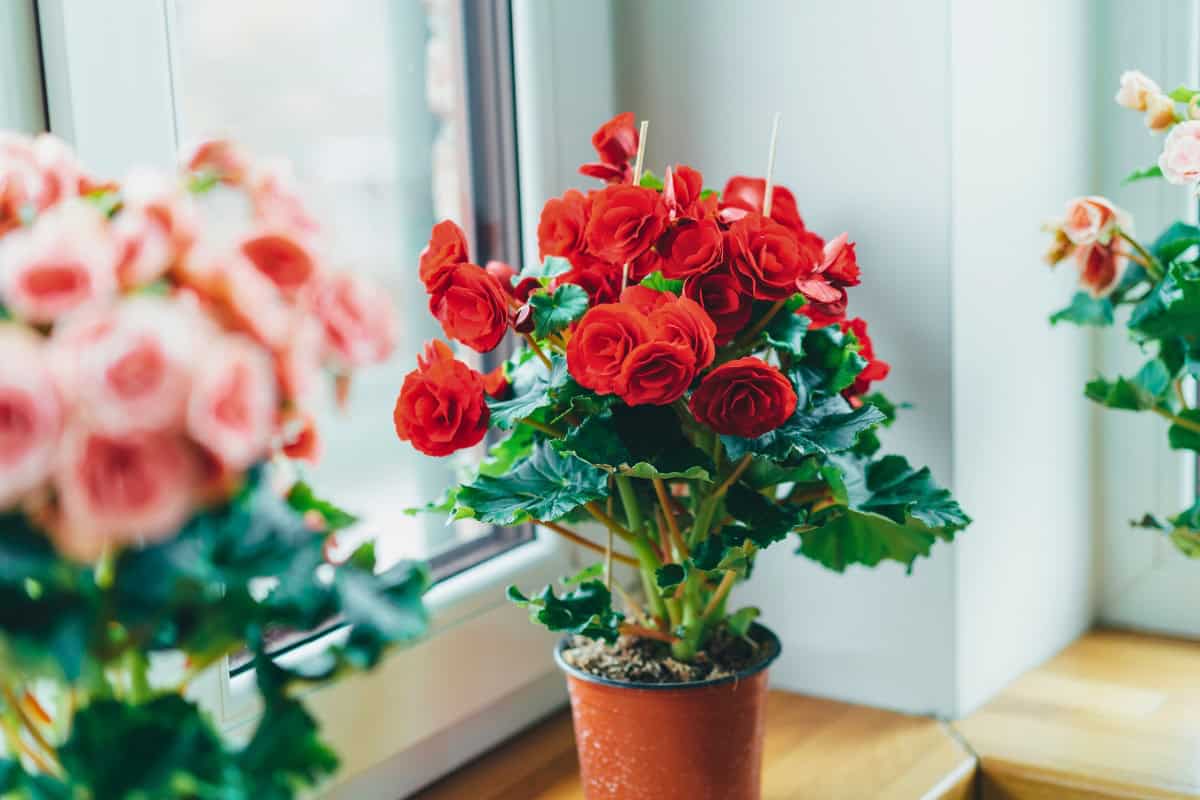
Begonias are the kind of plants that quietly win you over. At first, they seem like simple shade annuals. However, once you notice their color ranges, leaf shapes, flower forms, and growing habits, you’ll see how beautifully they brighten shady beds and spill from hanging baskets.
But mistakes can happen when you plant begonias for the first time. Most begonia growing advice treats all varieties the same. This guide doesn’t; here, you’ll learn:
- The number-one mistake that kills most begonias.
- Why getting pot size wrong guarantees problems.
- How to plant begonias and set them up for success.
- The most common reason propagation fails.
You’ll learn about the primary types of begonias, including what each actually needs and how to avoid crucial planting and care mistakes.
Step #1: Know Your Begonias
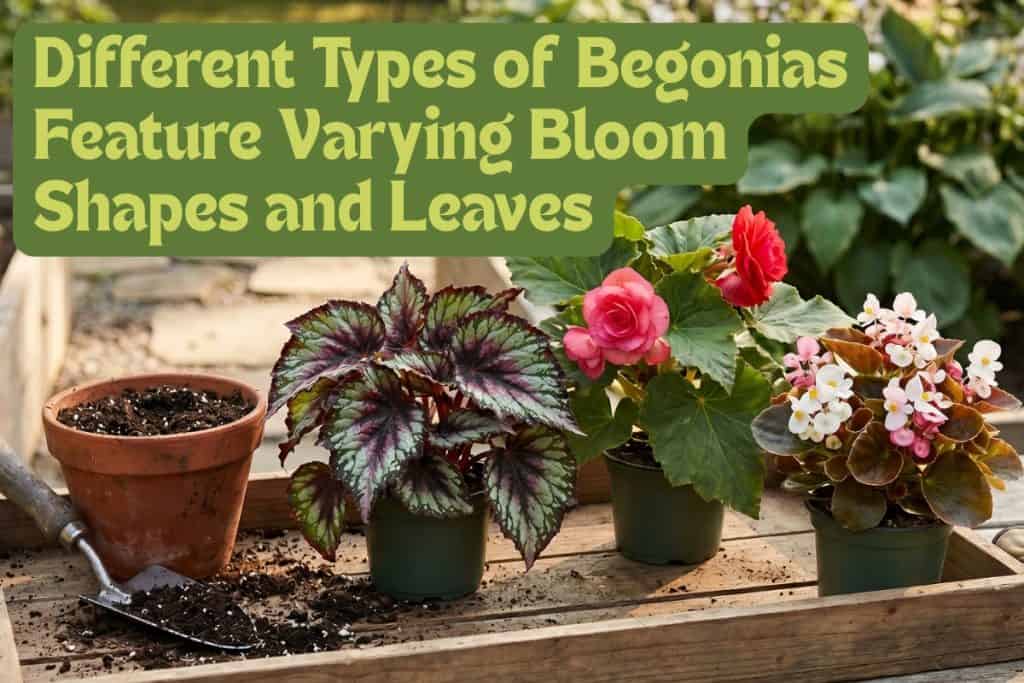
Not all begonias grow the same way. While the basic care instructions are similar, begonia varieties do differ in size, flower type, sun tolerance, growth habit, and how they handle winter.
Begonia Qualities
Generally, most begonias share these qualities:
- Continuous seasonal blooming.
- Decorative foliage.
- Trailing habit that’s suitable for hanging baskets.
- Deer-resistant.
- Pollinator-friendly.
- Adaptable as indoor winter houseplants.
Common Begonia Types
As you consider which type of begonia to buy, consider how you want to use the plant. Then, match that intent to the groups below.
- Tuberous Begonias: Feature large, showy flowers and foliage that ranges from dark and scalloped to plain green. Grows well in containers. Varieties include Nonstop, Mocha, and Exhibition.
- Wax Begonias: A classic bedding type that is compact and widely available, with green or bronze foliage and white, pink, or red flowers.
- Wax Begonia Hybrids: Larger, faster-growing plants that are more heat tolerant than traditional wax begonias. Varieties include Megawatt, Top Hat, and Viking.
- Begonia Boliviensis: Features thin leaves and flowers that hang downward on arching stems. Santa Cruz is one type.
- Rieger Begonias: Upright plants bred for heavy flowering, with dense clusters of blooms and leathery green foliage. Commonly grown as indoor or patio plants.
- Rex Begonias: Grown primarily for dramatic foliage in unusual colors and leaf shapes.
- Angel Wing or Cane Begonias: Feature upright stems and wing-shaped leaves often marked with silver spots. These plants work well in containers or indoors.
- Dragon Wing Begonias: Strong-growing begonias with bright green leaves and red or pink flowers that handle sun or shade better than most and fill space quickly.
Which Begonias Are Best?
The best type of begonias for your garden or home ultimately depends on what you’re looking for.
If you’ll be planting in outdoor beds, Dragon Wing, Viking, and some boliviensis and hybrid wax begonias are the best choice as they’re adaptable in most conditions.
If you’d like dramatic blooms, tuberous begonias are hard to beat. If foliage is your priority, Rex begonias are the clear choice.
Step #2: Prepare the Soil or Growing Medium
Soil matters significantly to begonias. It’s easy to mess up, but if you get the drainage right, most other mistakes are fixable.
All begonias need the same two things from their growing medium: Water needs to move through freely, and the mix should never stay soggy between waterings.
Begonia Container Growing Medium
If you’re growing begonias in a container, good news: Containers give you complete control over the root environment. But that’s only if you start with the right mix.
A potting mix designed for containers is the best starting point. You do not want to use garden soil, as it compacts under repeated watering, loses its structure, and drains poorly.
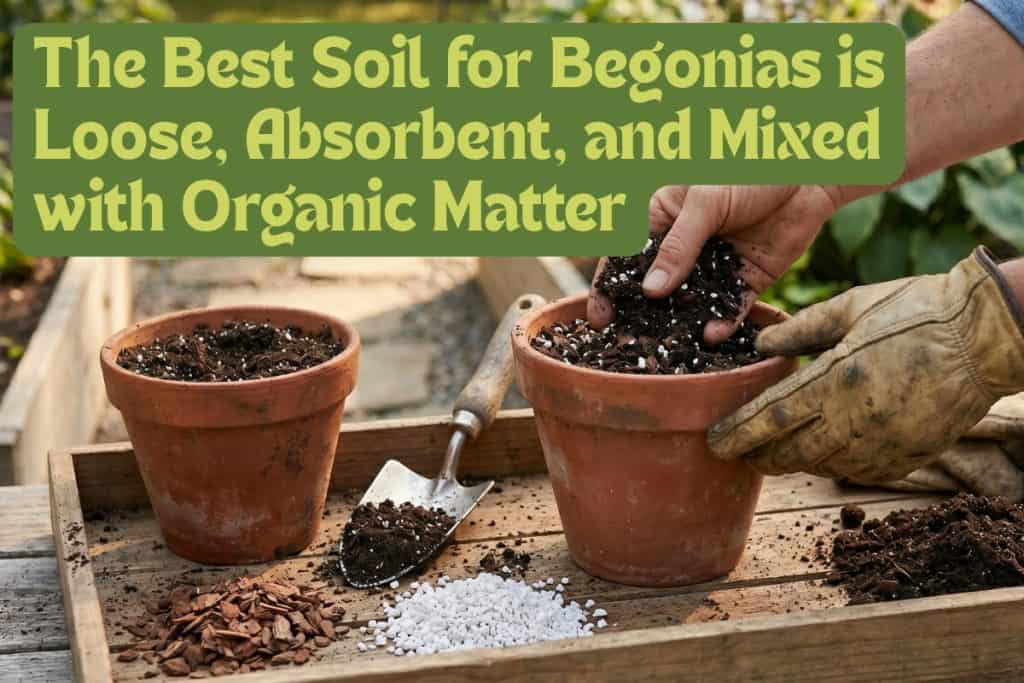
The ideal growing medium for container-grown begonias is:
- Lightweight and loose.
- Free-draining, allowing water to run through within seconds.
- Mixed with organic matter, like peat or bark.
- Amended with perlite if the mix feels heavy or slow to drain.
In-Ground and Raised Bed Soil for Begonias
Garden soil requires more evaluation than container mix because you’re working with what’s already there. The goal is a bed that drains after rain but holds enough moisture and nutrients to support continuous flowering.
The ideal soil for begonias growing in-ground or in a raised bed:
- Is dark and loose, with visible organic matter.
- Crumbles easily when dry.
- Absorbs water, but doesn’t hold standing water after rain.
- Amended with compost to improve drainage and fertility.
If your soil is clay and stays soggy after rain, don’t plant begonias there until you fix the drainage. Raised beds are a good alternative; alternatively, you can amend a flat area with compost and coarse sand until the soil drains normally.
Step #3: Plant Your Begonias
The success or failure of your begonias depends on two factors: crown height and fast drainage.
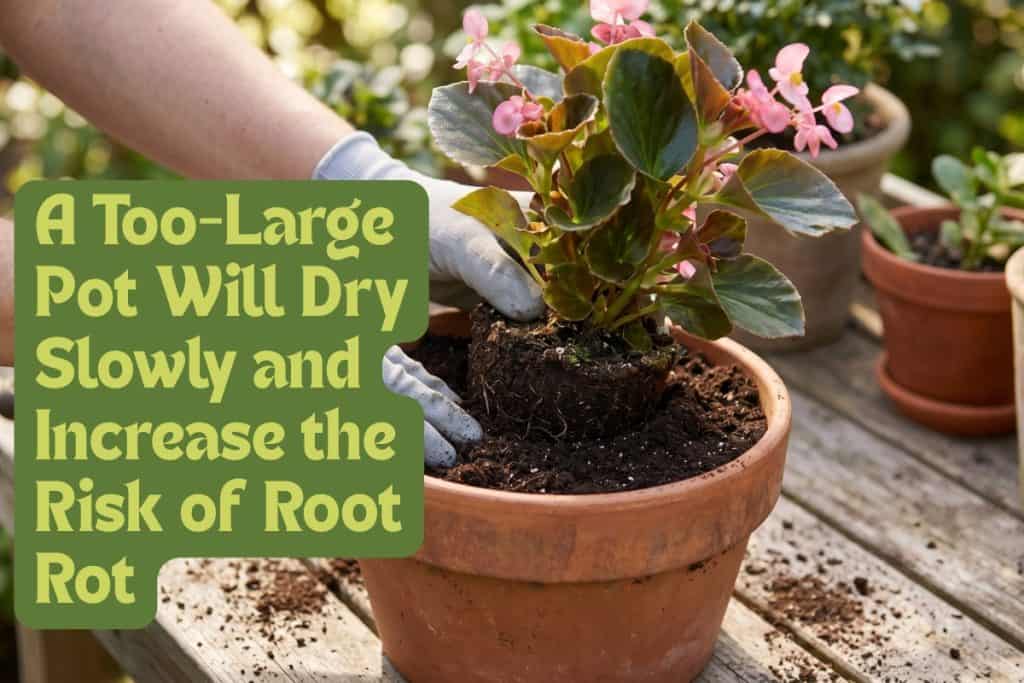
When you’re ready to plant, this means you’ll need to set the plant so the crown (where stems meet roots) sits level with or slightly above the finished soil line. If the crown is buried, moisture will stay trapped at the base, oxygen will drop in the root zone, and the plant will struggle or rot before it establishes.
Follow the steps below to prepare begonias for planting and get them in the ground (or container).
4 Steps: Prepare the Root Ball
- Slide the plant out of its nursery pot.
- Loosen only the outer circling roots; leave the core intact.
- Remove any dead, black, or sour-smelling roots.
- Pre-moisten your growing medium so it’s evenly damp but not soggy.
Choose a Container
Controlling wetness is crucial for container planting. Start by choosing a pot that supports even drying and never traps water at the crown.
As you choose a container, consider these tips:
- Small pots dry fast, but they can stress plants in heat.
- Oversized pots dry slowly, increasing rot risk.
- Wider pots usually dry more evenly than tall, narrow ones.
7-Step Container Planting Protocol
- Choose a pot slightly wider than the root ball.
- Make sure your pot has multiple drainage holes.
- Loosely fill the pot with pre-moistened mix.
- Set the plant’s crown level with or slightly above the mix.
- Backfill with soil and firm gently to stabilize.
- Water and let it drain fully.
- For hanging baskets, resist overfilling; plants will look fuller once they branch.
In-Ground Planting
In-ground begonias thrive when root-zone conditions don’t change, so consistency matters. Spacing is key, too, as too-tight spacing creates overlapping canopies that will hold humidity and increase disease risk.
Before putting your begonias in the ground:
- Group plants by growth speed so one variety doesn’t overwhelm another.
- Use wider spacing in humid climates.
- Space plants so they touch lightly when fully grown.
Pro Tip: To calculate how many plants you need for a bed or border, use a spacing calculator (like landscapecalculator.com).
6-Step In-Ground Planting Protocol
- Avoid single-hole planting in compacted soil; loosen a wider area when possible.
- Set the crown level with the finished soil line, not below it.
- Backfill gently with soil.
- Water deeply once and let it drain fully.
- Keep watering steady while establishing; avoid wet-dry cycles.
- Mulch with about 2 inches of organic mulch (e.g., bark), pulled back from the stems.
Step #4: Give Begonias the Right Light
Light determines how well begonias flower, how quickly soil dries, and leaf health. Get the lighting right, and most other variables become more forgiving.
For most begonias, partial shade is ideal. Aim for about 4 to 6 hours of direct sun, with protection during the hottest part of the day.
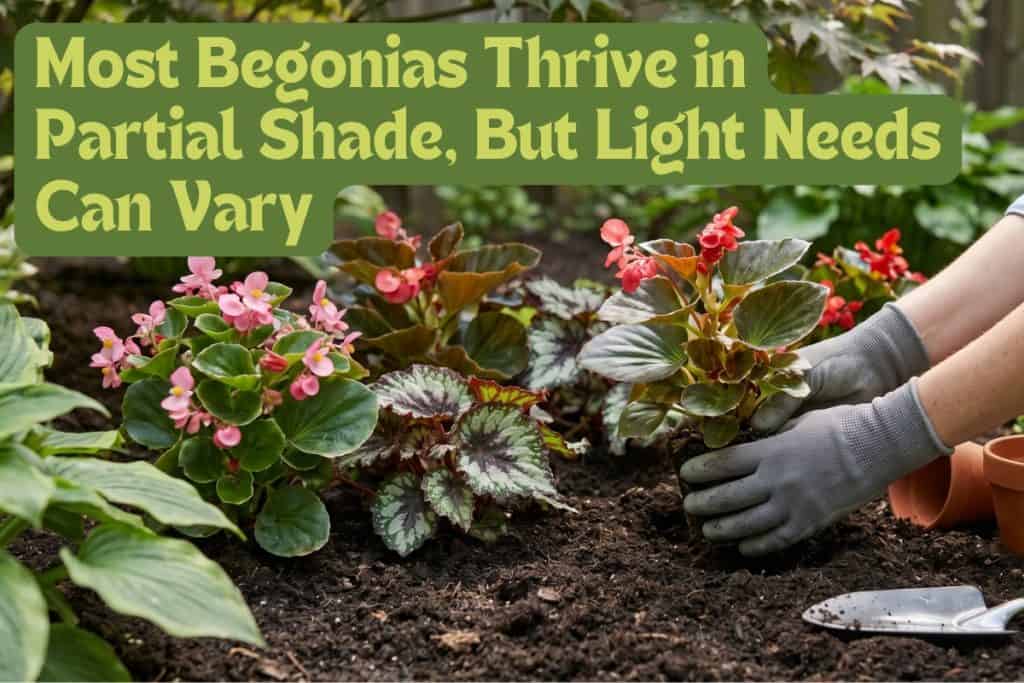
Eastern exposure works well, as this gives plants morning sun and afternoon shade.
Is Your Begonia Getting the Right Light?
- Too Much Sun: Scorched leaf edges, bleached-out flowers, or wilting despite adequate water.
- Too Little Sun: Stretched stems or sparse blooms.
- Indoors: Aim for bright indirect light; direct window sun can scorch leaves.
Orchids also thrive in bright indirect light, so read our orchid growing and care guide here.
Light by Begonia Type
Not all begonias want the same amount of light exposure. Shade-oriented types, including Rex begonias, Angel Wing or cane begonias, and Rieger begonias, prefer filtered or indirect light.
Adaptable types, like Viking, Dragon Wing, or begonia boliviensis types, may be able to handle full sun to full shade.
Step #5: Water Begonias Properly
Begonias like evenly moist soil, but constantly wet roots are a problem. These plants often have succulent stems and thick, leathery leaves that store moisture, so they usually need less water than other bedding plants.
Read our guide on growing succulents here, a plant that stores water in a manner similar to begonias.
Begonia Watering Protocol
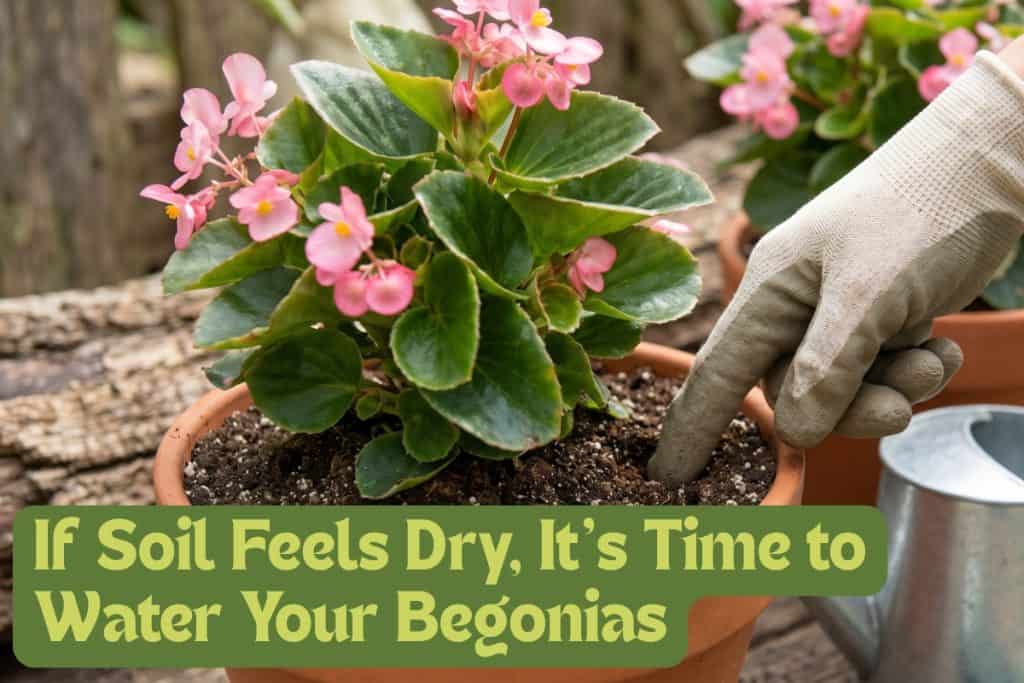
After planting, you’ll want to water your begonias so the roots settle into moist soil, then let the top inch dry before watering again.
Always water at the soil level when possible and try to keep the flowers dry. Soaker hoses, which handle both simultaneously, are the ideal choice for begonias in beds.
Keep these tips in mind every time you water:
- Insert a finger about 1 inch into the soil. If it feels dry, it’s time to water.
- If foliage droops on hot afternoons while the soil is still wet, don’t add water. Reduce sun or wind exposure and improve airflow instead.
- For container plants, let water drain completely, then empty saucers after watering.
- If the soil in potted begonias begins pulling away from the inside edge of the pot, it’s time to water.
Step #6: Fertilize Begonias Consistently
Because begonias bloom continuously, they use a lot of nutrients — especially when they’re planted in containers.
Potting mix runs out of nutrients fast, so feeding container begonias should be part of your normal care routine.
The Best Fertilizer for Begonias
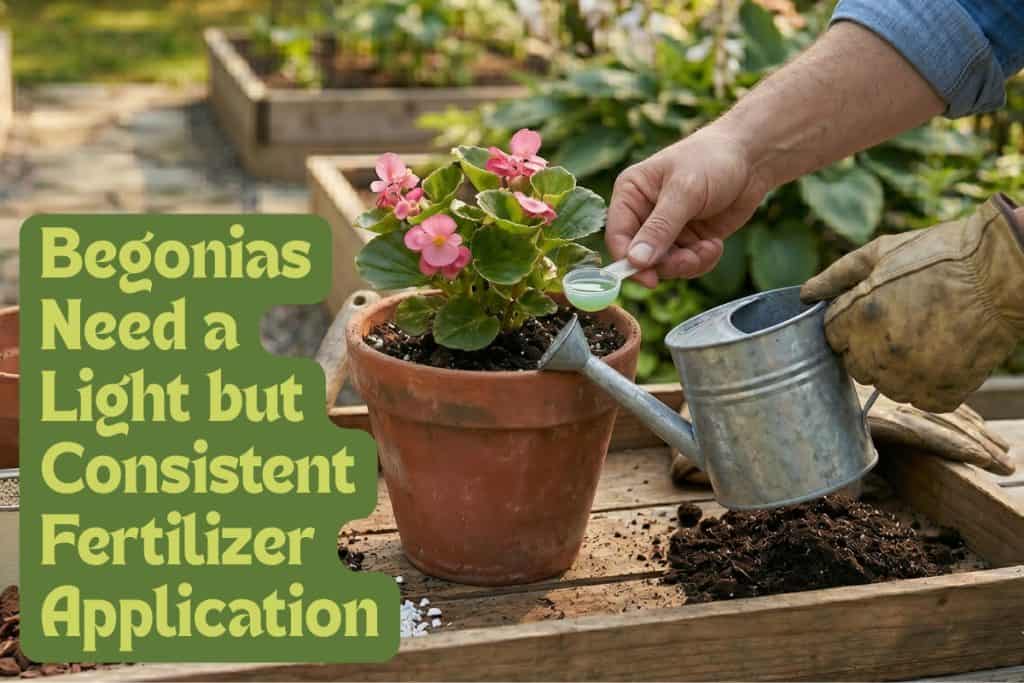
You should fertilize begonias with consistent, light feedings. A balanced fertilizer with micronutrients works well.
Mix a slow-release fertilizer, such as Osmocote 14-14-14, into the potting mix at planting. Then, as your plant grows, add liquid fertilizer as needed.
Signs of Over- and Underfeeding
- Overfeeding: Produces lots of leaves, few flowers, and lush, dark, soft tissue that breaks easily, attracts pests, and is more prone to rot.
- Underfeeding: Causes slow growth, pale or yellowing leaves, and smaller flowers over time.
- Salt Accumulation in Containers: Mimics water stress with wilting and poor growth even when the mix is wet.
4 Steps to Fertilize Begonias
- Fertilize when you see new growth after planting or repotting.
- Use a balanced fertilizer at a “weakly, weekly” approach: Fertilize at half strength every week. (Skip if you are using a slow-release fertilizer.)
- Reduce feeding during cool or cloudy periods when growth naturally slows.
- Water with plain water every few weeks until it drains freely to leach accumulated salts.
When Not to Fertilize Begonias
If a plant has been root-disturbed, under temperature stress, or struggling with disease, fertilizing won’t help.
Instead, correct the environment before you apply any more fertilizer. Adjust or improve drainage, light, or temperature, then resume feeding once you see signs of active growth.
Step #7: Prevent Pests and Pet Problems
Begonias are not pest-prone, but they’re not immune. So, you’ll want to keep an eye out for potential pest woes.
A light infestation that’s caught early takes minutes to treat, but the same infestation two weeks later can mean losing the plant.
Common Begonia Pests
- Spider Mites: Signs include fine webbing on stems and leaf undersides. Dry indoor air and warm temperatures speed their spread.
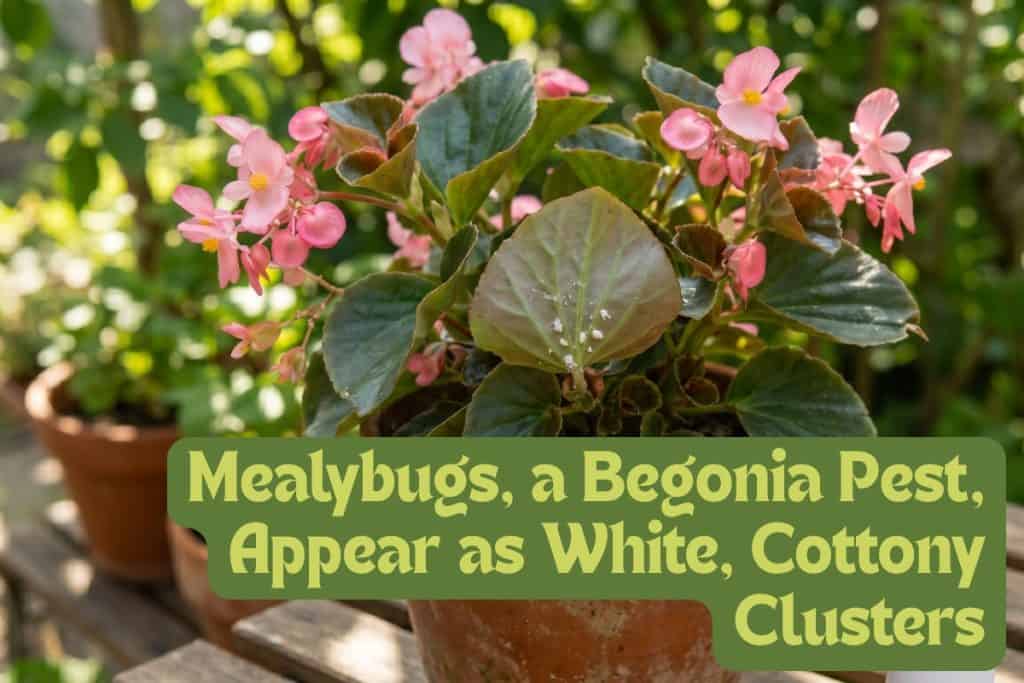
- Mealybugs: Appear as white, cottony clusters in leaf axils and along stems. Hard to eliminate once established.
- Whiteflies: Tiny white insects that fly up when disturbed. More common on outdoor plants.
- Thrips: Slender, fast-moving insects that leave silvery streaking or distorted growth.
Pest Prevention Protocol
- Inspect plants before buying: Check leaf undersides, stem joints, and the soil surface.
- Rinse the foliage with a steady stream of water to dislodge insects and eggs.
- Apply insecticidal soap to leaf surfaces, including undersides, and let it dry completely.
- Isolate new plants for at least a week before bringing them near established ones.
Should You Use Systemic Granules?
For recurring pests, some growers use systemic granular insecticides worked into the soil. Systemics move through the plant tissues, which makes them effective against insects that feed on leaves.
However, this pest treatment doesn’t work on spider mites since they aren’t insects.
If you do want to use these granules, wear a mask when applying and keep treated soil away from children and pets. Do not use them near edible plants.
Keep Pets Away from Begonias
Begonias are toxic to cats and dogs, so this plant can become a problem for pet owners.
The tubers have the highest concentration of toxins, but all parts of a begonia carry some risk. If you have animals that chew on plants and have indoor begonias, be sure the plants are out of their reach.
Step #8: Deadhead and Groom Begonias
Begonias need grooming not only for their looks; it’s also key to preventing rot and diseases.
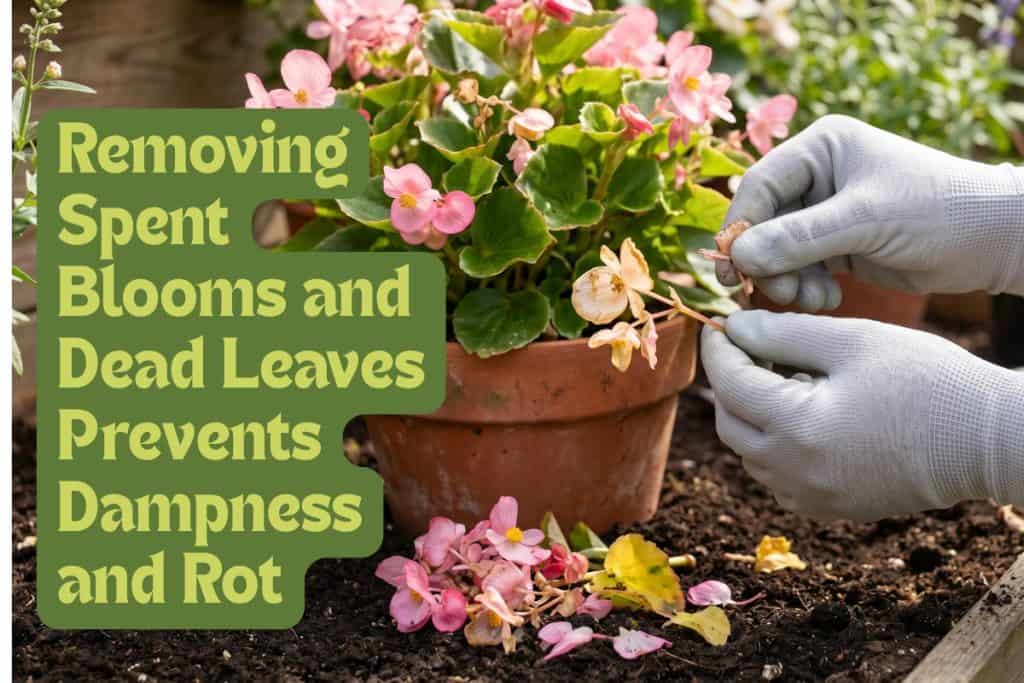
Spent blooms, dropped petals, and yellow leaves trap moisture in the canopy. With large-flowered tuberous begonias, fading blooms sitting against leaves creates dampness that encourages rot.
How to Groom Begonias
- Deadhead early by removing spent blooms and fallen petals trapped in leaf joints.
- Remove yellowing or damaged leaves; don’t leave soft stubs.
- Clear the canopy floor so moisture and fungus don’t build at the base.
Some begonia plants may need slightly different maintenance, such as:
- Dragon Wing and Wax Types: These are often self-cleaning, so you can deadhead after storms or damage.
- Large-Flowered Tuberous Types: Deadhead consistently, as wet petals in leaf axils are a common cause of rot.
Step #9: Pinch, Prune, Shape, and Support
Grooming keeps begonias clean, but shaping keeps them structurally sound. The best-looking plants are shaped early, while stems are flexible and small cuts redirect growth and encourage branching.
Waiting until a plant is tall, tangled, or top-heavy forces harder pruning, delays bloom, and increases breakage.

3 Goals for Shaping Begonias
- Multiple sturdy stems, not one tall leader.
- An open structure that doesn’t shade itself out.
- Stems thick enough to hold flowers without flopping.
Pro Tip: When shaping, you want to make light cuts early, always cut to a node, and remove weak stems instead of shortening everything evenly.
Early- and Mid-Season Shaping
- Pinch tips early on cane, trailing, and boliviensis types to force branching.
- Cut back to a node selectively; don’t cut the whole plant uniformly.
- Remove the weakest or most crowded stems at the base (especially on tuberous types) so remaining stems can thicken.
Shaping by Begonia Type
- Cane or Angel Wing: Benefits from early tip cuts to prevent tall, bare stems and encourage branching.
- Wax or Hybrid Wax: Needs minimal shaping; shear lightly only if uneven or leggy.
- Tuberous: Prioritize stem selection and thinning early so remaining stems can support heavy blooms.
- Rex or Rhizomatous: Avoid routine pruning and trim rhizomes only at repotting or division.
- Trailing or Basket Types: Selective tip pruning builds fullness; avoid hard cutbacks.
How to Add Structural Support
Support works best when it’s installed before begonia stems lean. If they’re already flopping and breaking, support likely won’t help.
Follow these steps to add structural support:
- Choose Main Stems Early: Remove the weakest, most crowded ones at the base.
- Install Stakes or a Support Ring Early: This helps stems grow into support naturally.
- Tie Loosely: Use Velcro to avoid cutting into thickening stems and adjust ties as growth expands.
Prepare Begonias for Winter
Begonias don’t have to be a one-season investment. Most can survive winter with the right approach, but that approach will depend on your exact begonia type.
Tuberous and non-tuberous types require different treatments when temperatures decrease.
Bring Non-Tuberous Begonias Indoors
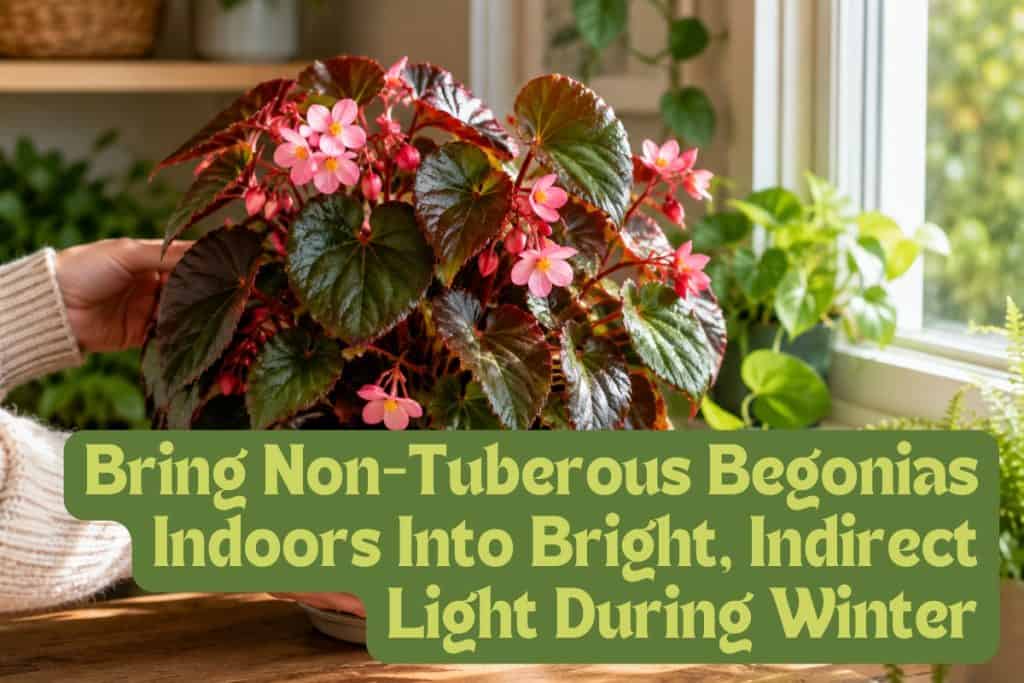
Wax, cane, and rex begonia types don’t go dormant; they’re cold-sensitive. So, your goal is to keep them alive and slowly growing until warm weather returns.
Bring these plants inside before evening temperatures reach freezing. While they’re indoors, provide bright indirect light and reduce watering. They don’t want a dry rest; they want a slow one.
If you’re expanding your indoor plant collection for winter, read our snake plant care guide here.
Indoor Care Protocol
While indoors, non-tuberous begonias can suffer from low light, overwatering, and pest pressure (due to reduced airflow). Address all three with these care steps:
- Place begonias in the brightest indirect light available.
- Reduce watering frequency; let the top 1 to 2 inches of soil dry before watering.
- Inspect regularly for spider mites and whiteflies, which thrive in warm, dry indoor conditions.
Store Dormant Tuberous Begonias
Tuberous begonias go dormant in winter, and if they are kept warm without a rest period, they sprout early and grow weak. Work with the dormancy cycle, not against it.
Watch for the cues of dormancy: Yellowing leaves, leaf drop, and slowed growth. Don’t wait for hard frost.
When the plant goes dormant, store tubers with the goal of controlled dehydration. Keep them dry enough to suppress rot but not so dry they shrivel.
Like tuberous begonias, Christmas cactus care changes seasonally; read our Christmas cactus guide here.
5 Steps: Storing Begonias
- Before the first hard frost, cut back foliage and lift tubers carefully.
- Brush off loose soil and store in a dry, airy spot for 1 to 2 weeks.
- Pack loosely in a breathable container, like paper bags or mesh (never sealed plastic!). Plants can also be hung upside down like herbs.
- Store in a cool (45 to 55 degrees Fahrenheit), dark, dry location.
- Inspect monthly and remove any soft or moldy tubers immediately.
How to Propagate Begonias
Once you’ve gotten your begonias growing, odds are you’ll want more. Luckily, begonias propagate readily, but the method by which you do so matters.
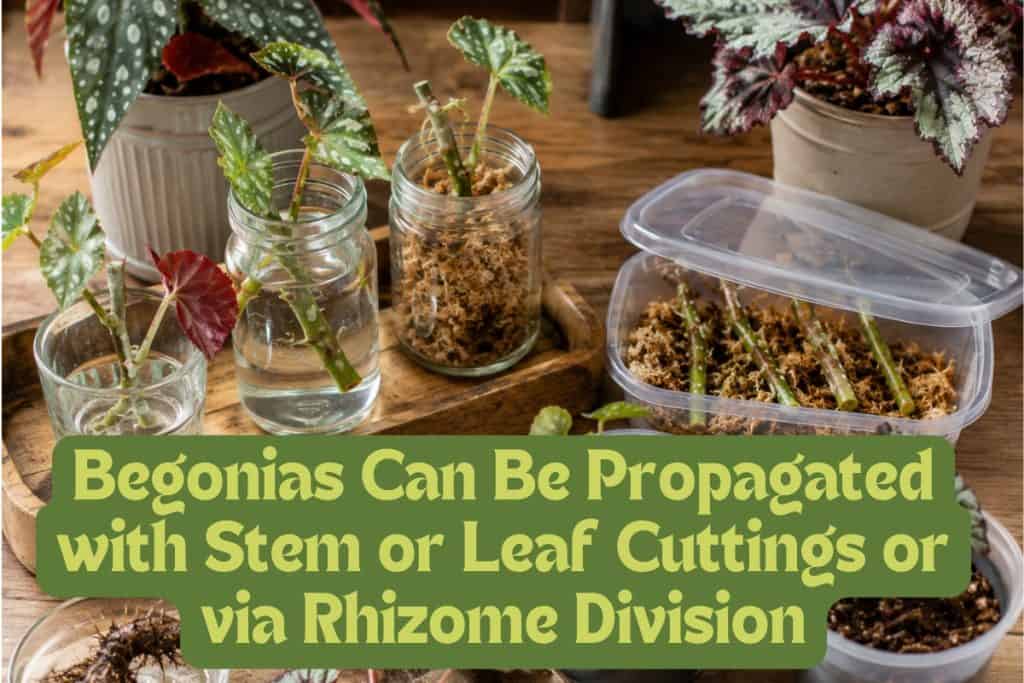
Propagation differs based on type, too. Cane begonias, for example, have upright stems with nodes (the joints where leaves attach and roots form), making them natural candidates for stem cuttings. Rex begonias, meanwhile, grow from creeping rhizomes near the soil surface and propagate better from leaf cuttings or rhizome division.
Propagate Cane Begonias: Stem Cuttings
When you’re propagating cane begonias, the goal is to get the stem cutting into a clean rooting setup quickly. You can place stem cuttings in either water or moss.
If you’re using water:
- Cut a healthy stem section just below a node.
- Submerge the node (keeping the leaves out of water).
- When roots reach about 2 inches, pot in well-draining mix.
Expect a brief adjustment period after potting, as water roots are less structured than soil roots.
If you’re using moss:
- Cut sections so each piece includes a node.
- Put the node into moist (not dripping wet) sphagnum moss.
- Enclose in a clear container or sealed bag to hold humidity.
- Once roots form, then pot.
Propagate Rex Begonias: Leaf Cuttings or Rhizome Division
Rex begonias are propagated by leaf cuttings or rhizome division, not stem cuttings.
To use leaf cuttings:
- Take a healthy leaf with its petiole intact and place only the petiole in water, keeping the leaf blade above the waterline.
- Place the cutting in bright, indirect light and warmth to speed rooting.
- Roots should typically form within two weeks.
- Pot once roots reach 2 inches, using a well-draining mix and after dipping the cut end in rooting hormone.
To divide rhizomes:
- Divide at repotting during active growth, cutting into sections with at least one growing point (and ideally some existing roots).
- Plant shallowly.
- Keep evenly moist until new growth appears.
Growing Begonias from Seed
Begonias can be grown from seed, but the process can take up to four months to reach usable size. Cuttings and division are faster and more reliable methods.
Final Advice
If you’ve ever walked past a bed of begonias and thought “maybe next year,” this is your sign.
Today’s begonias have come a long way from the familiar green-and-bronze bedding plant. Now, they have colorful wing-shaped foliage, trailing forms, bigger blooms, and full sun tolerance. They bloom for months and, once they settle in, they just keep going.
Happy growing!
10 thoughts on “How to Grow Begonias That Bloom All Season Long”
What do I do with the long stems after the flowers are gone from my Roger Begonia? Cut them off? Will it bloom again?
Don’t cut the entire long stem off just because the flowers are gone. Start by removing the spent flower clusters. Remove faded flowers and occasionally pinching back vigorous shoots to keep Rieger begonias attractive and encourage fuller growth.
If the stems have become very long, bare or floppy, however, you can shorten them. I would generally cut them back to a healthy leaf or leaf node rather than removing the whole stem at the base. This encourages branching and gives you a more compact plant.
Rieger begonias can be re-flowered after the initial flowers decline and says that when flowering stops, be patient, the plant can become a flowering houseplant again if it receives enough light.
Feed it with liquid fertilizer about once a month (like 8-8-8).
Best wishes.
What is the cause of curled leaves on begonias
They may be getting too much sun or not enough water. It could also be lack of humidity if they are inside. A combination of too much light and not enough water will cause the curling plus brown crispy edges. Too much water and too little water look the same if water stands and the plants don’t get enough air, so if they are outside about all you can do is keep them evenly moist.
I have yellow flowered begonias that stoped producing flowers and instead are growing long stems with what looks like could become a flower but doesn’t. How can I get it to bloom again it’s only July 13
You will need to do a little detective work. It could be too little light, too much nitrogen, inconsistent watering, or heat stress. Even though they are shade tolerate, they still have to have enough light to make energy to make flowers. Any fertilizer should be balanced (1o-1o-10) or low nitrogen 5-10-10 for example. You can control your watering, but if it has been super hot, not much you can do unless you have a way to shade them. Just do a little dectective work and see if you can narrow down the issue. Make sure lawn fertilizer isn’t going into the flower beds, they are high nitrogen. Best wishes.
This was so helpful. Thanks for the advice.
Thank you for visiting!
Is it true that the flat blossoms are the male an need to be taken off ?
That’s actually kind of a complicated question and depends on the type of begonia you are asking about. Begonias make separate male and female flowers on the same plant.
For tuberous begonias the male flower is the showier, fuller bloom (often looks “flatter” and more petal-packed), while the female flower is typically smaller and you can often see a swollen ovary/seed pod behind it. Gardeners sometimes pinch off the female buds so the plant doesn’t spend energy making seed.
For wax, cane, and rex begonias, deadheading is optional and they don’t work the same, but you don’t need to remove any buds or flowers.
Bottom line answer is deadheading spent flowers is good but you don’t need to select buds to remove and if you did, it would be the girls.