
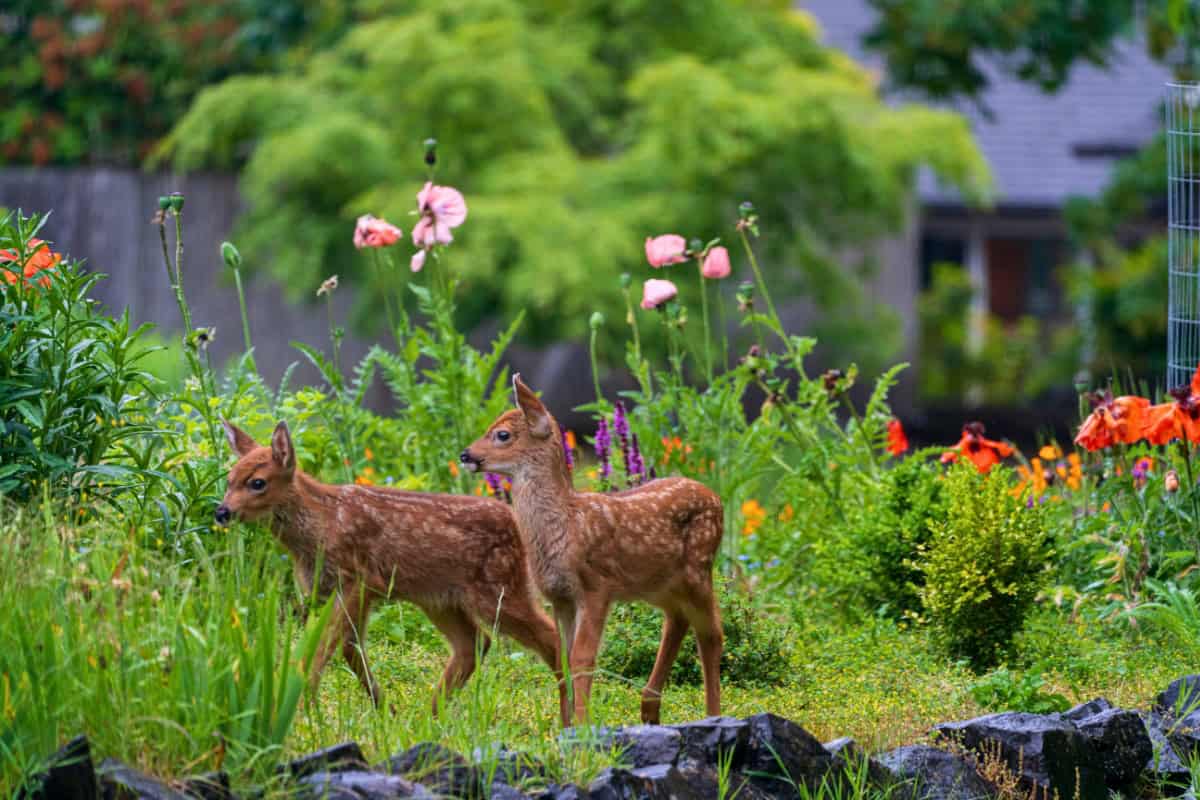
A deer-resistant garden is built on three principles: choosing the right plants, smart plant placement, and understanding what plants deer usually avoid.
Deer will eat almost anything when they’re hungry enough, so you likely won’t find plants they will never touch. Instead, your goal is to fill your garden with plants they would rather skip and arrange them so the whole area is harder to raid.
In this guide, you’ll learn:
- Why “deer-resistant” plants or gardens depend on your neighborhood.
- 5 traits that make a plant less appetizing to deer.
- Which plants are like candy to deer (and where to plant them anyway).
- How to choose a fertilizer that feeds your beds and helps keep deer out.
Ultimately, a deer-repelling garden is one that’s less appealing than others in your area.
What Does “Deer-Resistant” Really Mean?
Many gardeners think the phrase “deer-resistant” means “deer-proof” when it comes to plants. However, there’s no such thing as “deer-proof” plants.
Deer don’t browse plants from a fixed list. They respond to the season, local food supply, and how easy plants are to access.

It’s also important to consider deer pressure, which is a combination of the local deer population and how much plant material is available to eat. When plants are scarce, deer are likely to broaden the plants they eat.
Newly-planted gardens are more vulnerable than established ones because young growth is easier for deer to eat and often offers more nutrients.
Ultimately, deer-deterring plants are better understood as plants that deer tend to choose last, not ones that will never be eaten.
5 Traits of Deer-Resistant Plants
- Strong fragrance.
- Coarse, fuzzy, leathery, or sandpapery leaves.
- Bitter or toxic sap.
- Prickly or rigid stems.
- Sticky sap or foliage.
6 Plant Traits That Can Attract Deer
- Soft.
- Moist.
- High in sugar content.
- Newly planted.
- Actively growing.
- Easy to reach.
Tip #1: Plants Most Likely to Survive Deer
If you’re creating a deer-resistant garden, you want to choose plants that solve more than one problem at a time.
The best deer-resistant plants do more than taste bad to deer. They edge a path, fill open ground, support pollinators, or give a bed shape. They may even have large thorns.
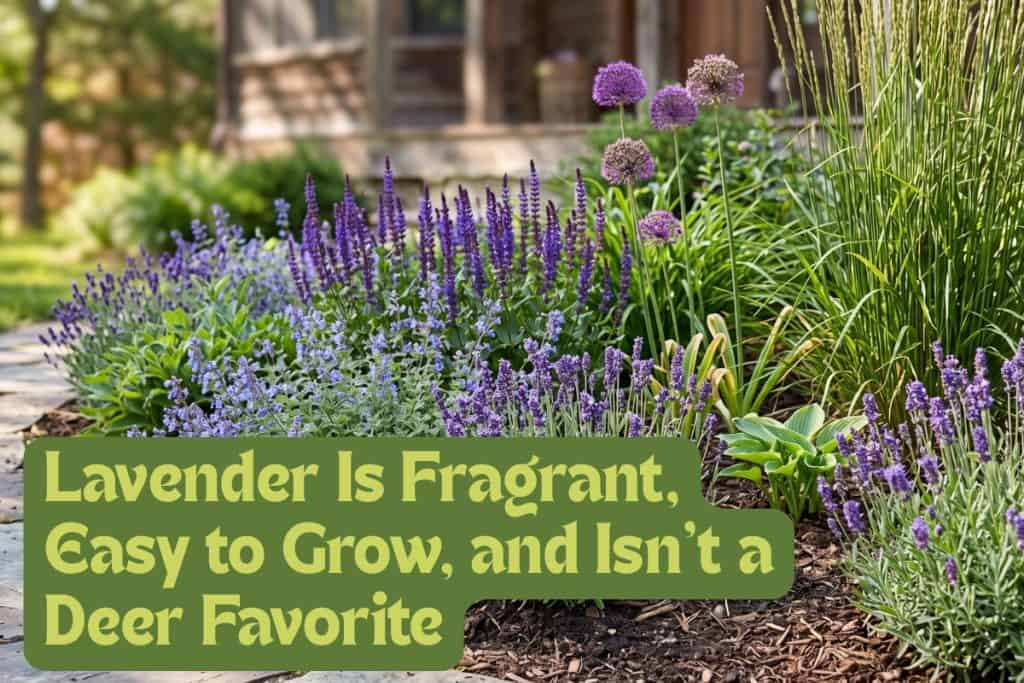
In most landscapes, that means you’ll want to plant ornamental grasses, aromatic herbs, alliums such as onion and garlic, hardy perennials, and a few dependable shrubs. These are the plants that can do the heavy lifting.
Once these are in place, more vulnerable plants can be layered in where they’re easier to protect.
5 Plants Deer Usually Avoid
- Lavender (Lavandula spp.): Fragrant and easy to repeat through sunny beds.
- Catmint (Nepeta spp.): Useful herb with a strong scent.
- Salvia (Salvia spp.): Long bloom time, fragrant foliage, very colorful.
- Alliums (Allium spp.): Useful for both ornamental and edible plantings.
- Ornamental grasses: Good for screening and outer-bed protection.
Rules for Successful Deer-Resistant Planting
- Protect new plants until they are established.
- Choose plants carefully for your garden’s site so they establish fast.
- Place vulnerable plants closer to your house.
- Place the toughest plants on your bed’s exposed edges.
- Avoid high-nitrogen fertilizer, which encourages soft growth.
Alliums like garlic are a great choice for deer-resistant gardens, and you can learn how to grow garlic here.
Tip #2: Top Flowers Deer Tend to Skip
Deer are usually attracted to leaves and stems more than flower blooms. I have seen whole beds of hostas eaten to the ground with only flower stems and flowers left. So, the most deer-resistant flowers tend to have the same traits as other plants deer avoid.
Deer-resistant plants either smell strong, feel rough or prickly or fuzzy, or contain toxic compounds that deer know to avoid. Start looking for those patterns instead of choosing flowers by color and bloom time, and you’ll lose fewer plants to deer.
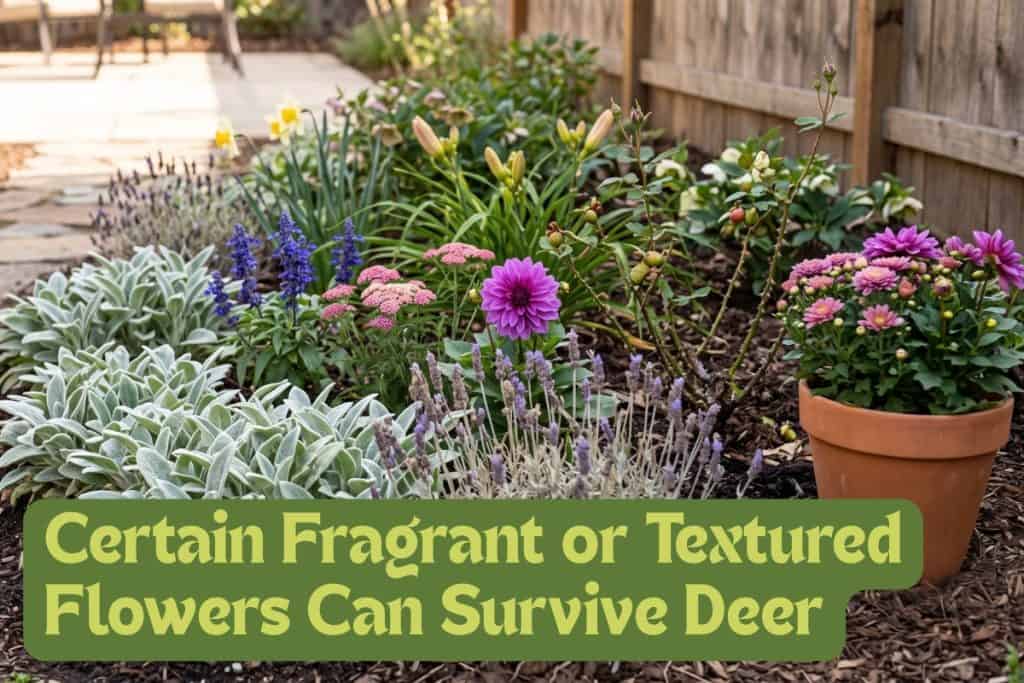
Categories of Deer-Resistant Flowers
- Fragrant flowers: Lavender, Salvia, and Agastache.
- Textured flowers: Yarrow, Lamb’s ear, Artemisia, and certain Dianthus.
- Chemically-protected flowers: Daffodils, Foxglove, Digitalis, and Lenten Rose.
Flowers That Need Protection
Some of the most popular garden flowers are also deer favorites. These plants are all worth growing, but they’re rarely the best choice for the most exposed part of your yard.
Deer often eat their flower buds before the flowers even open. These plants tend to produce soft growth deer find attractive, even if they have some thorns:
- Roses (Rosa spp.), particularly those with large hips (fruit).
- Tulips (Tulipa spp.), one of deer’s favorite spring flowers.
- Dahlias (Dahlia spp.)
- Garden mum (Chrysanthemum spp.)
- Daylily (Hemerocallis spp.), as deer strip the buds before they open.
In a sheltered area or low-pressure neighborhood, you may get away with these plants. In a yard with regular deer visitors, these plants should be treated as accents that need protection. Mixed plantings are usually safer than mass planting of the same plant.
4 Keys for Planting Deer-Loved Flowers
- Plant them behind resistant companion plants.
- Keep them near areas people use often, like paths, entryways, or patios.
- Plant in containers when possible.
- Avoid large blocks of soft growth. The softer the growth, the higher the risk.
Deer love chrysanthemums, but if you’re growing these flowers, follow the tips in our mums care guide here.
Tip #3: Durable Shrubs and Woody Bushes
Shrubs shape a garden in a way annuals and other short-lived flowers can’t. This is why browse damage matters more for shrubs than for annuals.
A nibbled annual can be replaced in a weekend. A browsed shrub, on the other hand, may lose years of growth and look uneven for a long time (maybe forever).

Deer-Resistant Shrubs
- Boxwood (Buxus spp.)
- Juniper (Juniperus spp.)
- Bluebeard (Caryopteris × clandonensis)
- Abelia (Abelia × grandiflora)
- Shrubby cinquefoil (Dasiphora fruticosa)
- Certain hollies (Ilex spp.)
- Trifoliate Orange (Citrus trifoliata)
Where deer populations are high, choose shrubs with thick branches, tough leathery leaves, sticky foliage, or a smell deer dislike. These plants are especially useful because they’re not only less appealing to deer, but also help shape the whole garden design.
One of the best examples is trifoliate orange. Deer don’t like this shrub’s smell, 2-inch thorns, or growth habit. The best use for the plant is including it in foundation plantings and as buffers around riskier shrubs.
High-Risk Shrubs Deer Love
Some high-risk shrubs are so common that gardeners typically assume they must be safe. Really, they only stay untouched where deer have plenty of other food. These include:
- Hydrangea (Hydrangea spp.)
- Arborvitae (Thuja occidentalis)
- Yew (Taxus spp.)
- Rhododendron (Rhododendron spp.)
- Azalea (Rhododendron spp.)
- Burning Bush (Euonymus alata)
High-risk shrubs should be planted where they have some shelter from browsing deer. That means placing them near busy, high-traffic spots where deer are less comfortable, screening them with tougher companion plants, or protecting them while they establish and become woody. Use them as special-use shrubs instead of base-layer shrubs.
A few arborvitae cultivars, such as ‘American Pillar,’ are more deer-resistant than the plain species, but young plants still need protection.
4 Steps to Lower the Risk of Deer Damage
- Plant high-risk shrubs close to the house.
- Screen shrubs with grasses, tall perennials, or more deer-resistant alternatives.
- Protect them during establishment until they’re woody.
- Avoid overstimulating soft growth with heavy feeding.
Learn how to grow hydrangeas in our guide, a high risk shrub that should be grown near high-traffic areas or with shelter.
Tip #4: Unpalatable Perennials
Perennials provide repeat color and texture in a garden, and the best ones don’t need to be rescued constantly. There are dependable deer-resistant perennials, all of which share similar traits like fragrant foliage, hairy leaves, slender threadlike foliage, coarse surfaces, or rigid stems.
Repeat these plants throughout a flower bed to make deer less interested and help the bed look more unified.
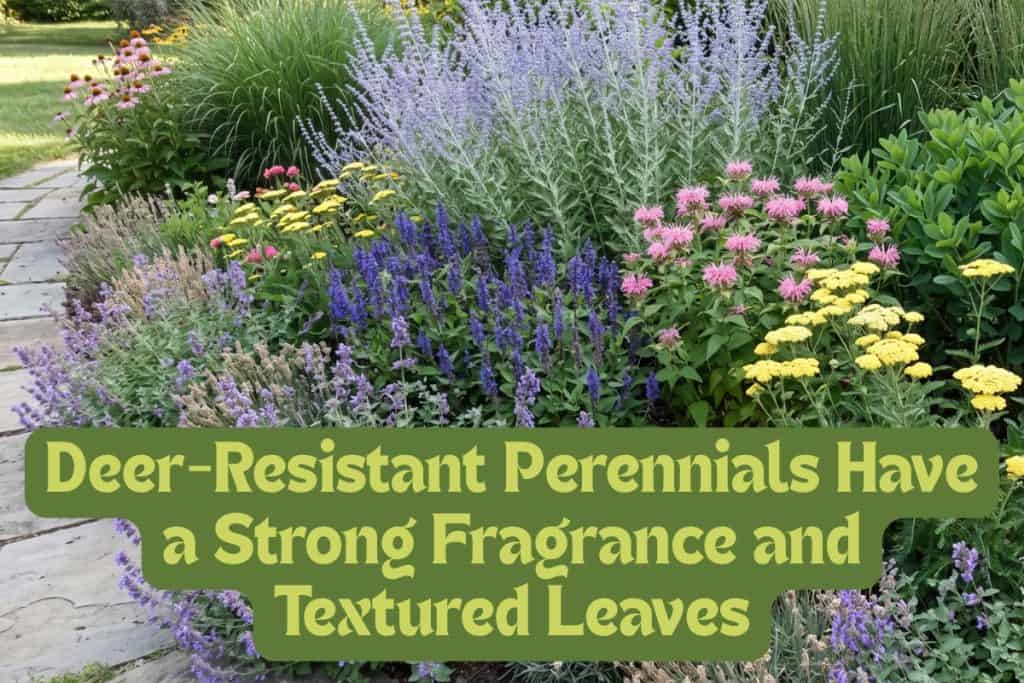
6 Deer-Resistant Perennials
- Catmint (Nepeta spp.)
- Salvia (Salvia spp.)
- Yarrow (Achillea millefolium and hybrids)
- Russian sage (Salvia yangii)
- Bee Balm (Monarda spp.)
- Baptisia (Baptisia spp.)
Where to Place Perennials
- Front-of-border plants: Catmint, Dianthus, Lavender
- Mid-border plants: Salvia, yarrow, bee balm
- Back-of-border plants: Russian sage, baptisia, ornamental grasses
Perennial placement can be a strong deer-discouraging strategy. I suggest using plants with the strongest smell or most distinctive leaf texture along the front or outer edge of a bed, where deer are most likely to start browsing.
More vulnerable plants can sit deeper in the planting, mixed among tougher and less tempting neighbors. This hides the softer plants from view and makes the border look fuller.
Useful Placement Ideas
- Repeat the same plants in groups.
- Use dense plantings instead of individual plants.
- Expect new tender divisions to need extra protection the first year.
- Instead of just color, use leaf shape, roughness, and fuzziness to add interest.
Tip #5: Low-Browsing Annuals
Annuals are usually the weakest point in a deer-prone garden because they’re fast-growing, soft, and often planted in the most visible parts of the landscape.
The key is to plant them where they are easiest to protect. Choose annuals that bring some resistance through texture or scent.
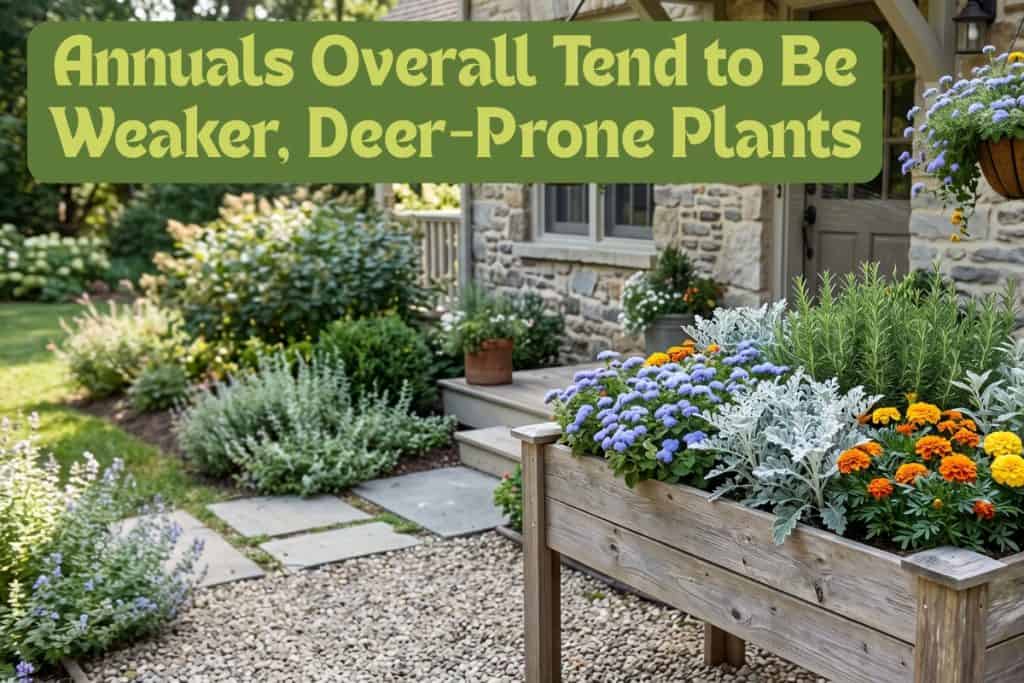
Annuals work best as accents within your garden rather than the main plants that hold it together. That means containers, porch pots, raised planters, and front entry beds make more sense for these plants than open beds and borders.
If you have a high deer population and plant annuals, you may also need to add deterrents such as sound, deer repellent, or motion-activated water sprayers.
5 Low-Risk Annuals
- Ageratum (Ageratum houstonianum)
- Dusty miller (Jacobaea maritima)
- Cleome (Cleome hassleriana)
- Marigold (Tagetes spp.)
- Sweet alyssum (Lobularia maritima)
High-Risk Annuals
- Petunia (Petunia × atkinsiana)
- Pansy (Viola × wittrockiana)
- Impatiens (Impatiens walleriana)
- Coleus (Plectranthus scutellarioides)
- Begonia (Begonia spp.)
If deer visit your garden often, these plants can still be left alone in the right spot. Usually that spot is one near human activity, above browsing height, or inside some protected setup.
5 Ways to Protect Annuals from Deer
- Use hanging baskets or raised containers.
- Plant annuals with tougher herbs or aromatic perennials and shrubs.
- Assume they may need replacing.
- Place near entryways and walks.
- Consider non-plant mechanical or chemical tactics like motion-activated sprinklers.
An annual like begonias can be high-risk, but you can learn planting and maintenance tips in our begonias care guide here.
Tip #6: Shade Plants
Shade gardens can be some of the hardest places to manage because they often border woods, fence lines, and quieter parts of the yard where deer already feel comfortable.
That’s one reason hostas are such a common problem. They’re beautiful, but in deer-prone gardens they’re essentially a buffet.
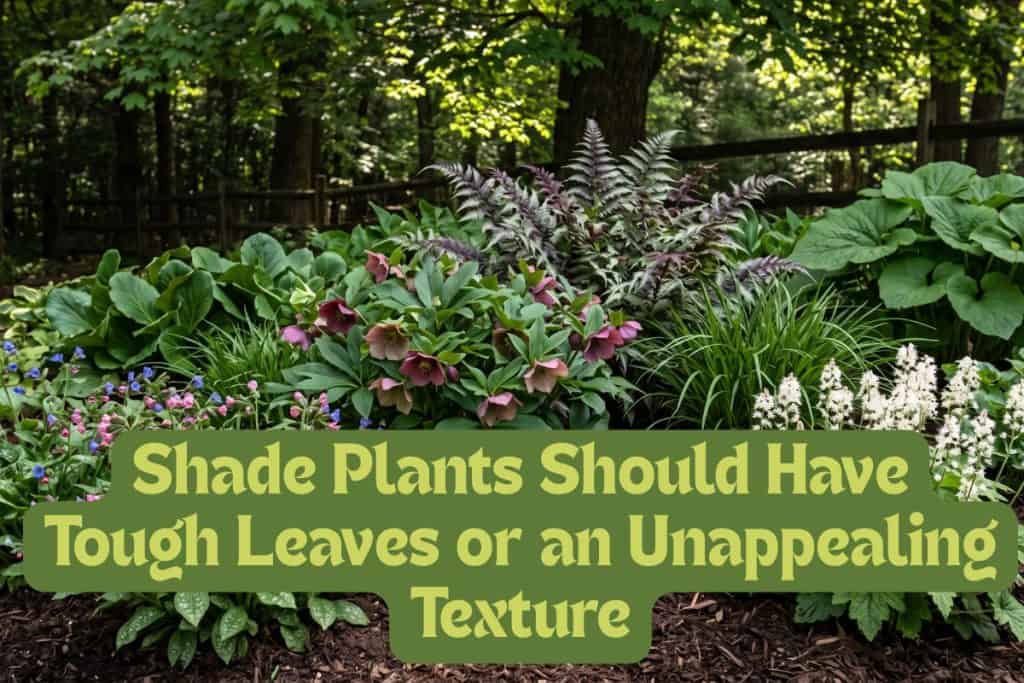
Better shade choices usually have tougher leaves, less juicy growth, or a texture deer do not like. The picks below are grouped by the job they do in the garden, so you can match a hosta stand-in to the spot you’re filling and still keep the space looking full.
Deer-Resistant Shade Plants by Role
- For bold foliage: Bergenia (Bergenia spp.), Brunnera (Brunnera macrophylla), and Lenten Rose (Helleborus spp.). Needs part to full shade.
- For woodland texture: Ferns, especially Japanese painted fern (Athyrium niponicum var. pictum), and Sedges (Carex spp.). Needs part shade to deep shade.
- For low edging and bed fronts: Epimedium (Epimedium spp.), Lungwort (Pulmonaria spp.), and Foamflower (Tiarella spp.). Needs part to full shade.
For the driest shade under mature trees, Epimedium and Hellebore hold up best. Where the soil stays slightly moist, lungwort and foamflower mat together the fastest.
Tip #7: Herb and Edible Gardens
Edible gardens are often exactly what deer want. A row of lettuce would be a deer’s dream. But some edible plants are less appealing, especially those with strong-smelling leaves.
If you’re looking to create a deer-resistant edible garden, herbs and the onion family are usually the safest bets and can help shape the outer edge of a kitchen garden. Hot pepper plants are deer-resistant unless food is in short supply in your neighborhood. These are all useful, easy to mix into a design, and generally less attractive to deer.

Safer, More Deer-Resistant Edible Plants
- Rosemary (Salvia rosmarinus)
- Thyme (Thymus vulgaris)
- Sage (Salvia officinalis)
- Oregano (Origanum vulgare)
- Chives (Allium schoenoprasum)
- Garlic (Allium sativum)
- Onions (Allium cepa)
Crops Deer Seek Out
If deer visit often, tender crops will need protection. Lettuce, beans, peas, strawberries, sweet potato foliage, and young brassicas (e.g., cabbage, kale, broccoli) are all highly attractive because they’re soft, moist, and easy to eat.
Edible gardens usually work best when planned with fencing, guards, and early protection first, then plant selection second.
6 Edible Plants That Deer Love
- Lettuce (Lactuca sativa)
- Beans (Phaseolus vulgaris)
- Peas (Pisum sativum)
- Strawberries (Fragaria × ananassa)
- Sweet potatoes (Ipomoea batatas), including ornamentals
- Corn (Zea mays)
Tip #8: Protective Trees
Trees present a different kind of deer problem because the damage they’ll cause isn’t limited to feeding.
Young trees can be browsed, but they can also be rubbed by bucks’ antlers, which strips bark and permanently damages branches. That means even a tree that’s fairly resistant once mature can still be vulnerable while young.
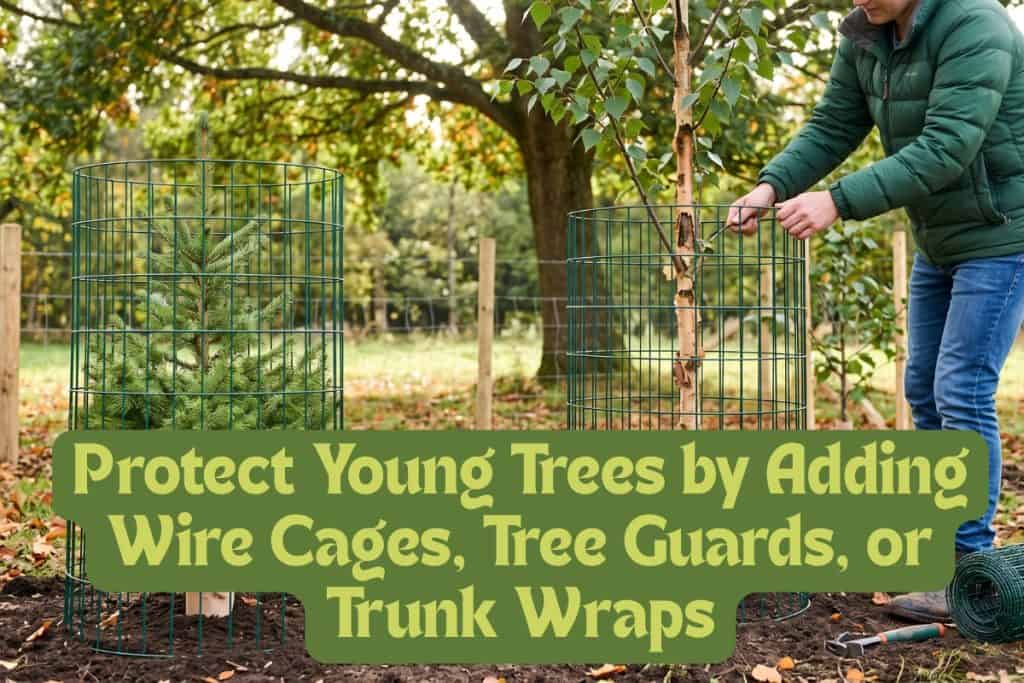
In deer country, tree choice and tree protection always go together. No newly-planted tree should be left unprotected if deer are common in your area, and a mixed planting is usually safer than relying on a single tree.
5 Trees for Deer-Prone Landscapes
- Eastern redcedar (Juniperus virginiana)
- Ginkgo (Ginkgo biloba)
- River birch (Betula nigra)
- Spruce (Picea spp.)
- Certain hollies (Ilex spp.)
How to Protect Young Trees
Deer-caused tree damage is costly and often permanent. Young trees are damaged more easily than older trees with woody branches.
A perennial can regrow, but a young tree with severe bark damage may never recover its form. Waiting until damage appears is usually too late. So, follow these steps:
- Add wire cages: Helps prevent browsing and rubbing. Install from August through December, before rutting starts to block antlers.
- Apply tree guards or trunk wraps: Good for preventing bark injury. Remove in spring after grass has greened up.
- Install temporary fencing: It’s useful when several young trees are planted together.
- Apply repellents: Apply on soft lower foliage before browsing begins.
- Monitor seasonally: This is especially important in late summer and fall.
Tip #9: Low-Susceptibility Ground Covers
Ground covers control weeds and reduce bare soil. They also sit at deer’s natural browsing height, which means the wrong choice can disappear quickly.
In deer-prone landscapes, the best ground covers function as living mulch while improving the garden’s appearance. New plantings are more vulnerable than established mats.

6 Deer-Resistant Ground Covers
- Creeping thyme (Thymus serpyllum and related species)
- Sweet woodruff (Galium odoratum)
- Low sedges (Carex spp.)
- Low junipers (Juniperus spp.)
- Pachysandra (Pachysandra terminalis)
- Vinca Minor (Vinca minor)
Erosion Control and Turf Alternatives
Swapping struggling turf for the ground covers listed above solves two problems at once. It holds soil on slopes and shady spots where grass thins out, and it takes a deer favorite off the menu.
Young ground cover plants are the most vulnerable, so add a light repellent spray or temporary netting through that first season while the planting knits together. Once the roots take hold and the foliage matures, the aromatic oils, tough leaves, or bitter sap that make these spreaders unpalatable will come fully into play.
How to Establish Ground Covers in Beds
Many ground cover failures happen in the first season. In deer country, it makes sense to plant a little tighter, mulch between young plants, and protect the area during establishment.
The goal is to get the planting rooted and a thick mat established as quickly as possible. Try these tricks:
- Plant closely: Thick groups of plants leave less new growth available for deer.
- Mulch between plants: Helps hold moisture and control weeds that might attract deer.
- Water for establishment: Once established, cut back and avoid keeping the area lush.
Tip #10: Plants That Repel and Deter Deer
Strongly-scented plants can make part of a garden bed less inviting to deer, but they won’t protect a large area on their own. They work best as a single layer within a larger plan.
Scent and texture also do more when planted in groups than as single plants dotted around. A cluster of smell is harder for a deer to walk past than one lone herb.
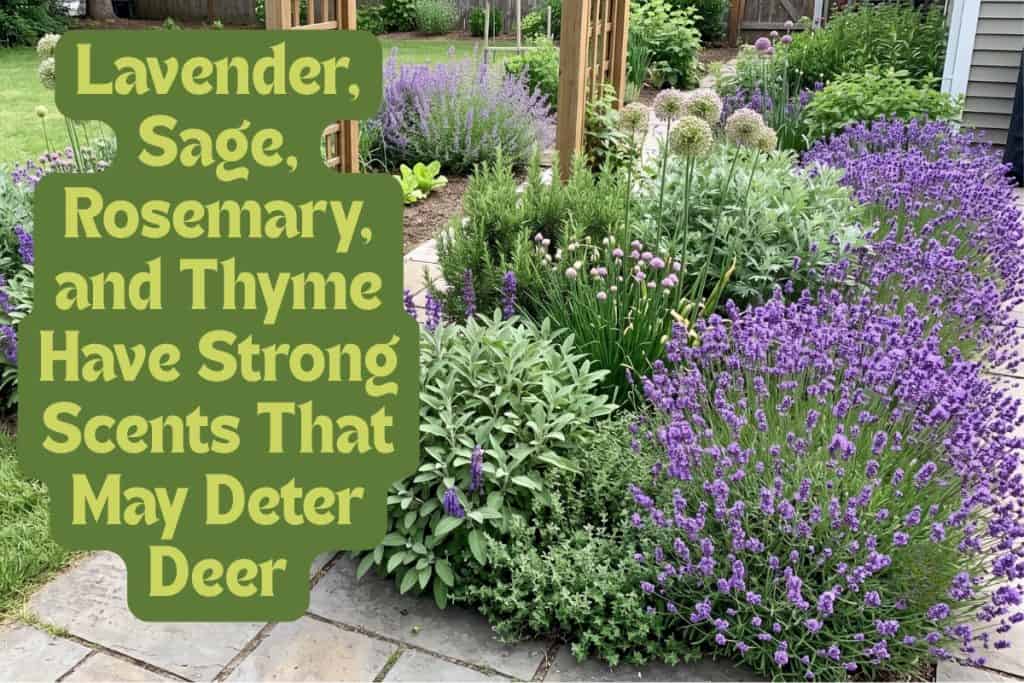
Useful Deer-Deterring Plants
- Lavender (Lavandula spp.)
- Sage (Salvia officinalis and ornamental Salvia spp.)
- Rosemary (Salvia rosmarinus)
- Thyme (Thymus spp.)
- Chives and ornamental alliums (Allium spp.)
- Artemisia (Artemisia spp.)
How to Use Deterrent Plants
Where you place plants matters as much as the plants you choose when it comes to deterring deer.
Put the strongest-smelling plants where deer first step into the yard. Hopefully, they will turn back or choose a different landscape before grazing.
The goal is not to stop every bite but make the garden less comfortable and less rewarding, so a deer drifts toward an easier, more inviting yard instead.
- Surround vulnerable plants with aromatic companions.
- Place them near entry points, at corners and transition zones.
- Run them along front edges and paths.
- Mix them into the edges of an edible garden.
- Pair them with barriers and other repellents.
Tip #11: Fertilizers That Feed Plants and Deter Deer
A few fertilizers can successfully do two jobs at once: They feed plants and make the ground smell “wrong” to a browsing deer.
Deer read a garden with their nose first, and a strong or unfamiliar odor tells them to move on. That’s why several nitrogen sources with an animal or earthy smell can cut browsing damage.

None of these fertilizers will replace a fence, and the effect fades as the smell washes away, so treat them only as another layer of protection. They work best on new plants and along garden edges. You’re building the soil while also making the bed less appealing.
Dual-Use Fertilizers
- Milorganite: Made from dried Milwaukee sewer sludge, this is a slow-release nitrogen fertilizer with an odor deer tend to avoid.
- Blood meal: Adds fast nitrogen and carries a scent deer, rabbits, and squirrels dislike.
- Fish emulsion: A liquid spray feed that works through leaf surfaces while its fishy smell deters browsing.
These cut deer browsing rather than stop it, but they fade fastest when deer pressure is high and other food is scarce.
How to Use Feed-and-Deterrent Fertilizers
- Spread Milorganite over beds and borders at label rates, then reapply every few weeks or after heavy rain.
- For a stronger smell, tuck Milorganite into small cloth bags and hang them off the ground near vulnerable plants.
- Scatter blood meal inside the bed, away from the edges, and water it in so pets are less tempted to lick it up.
- Spray fish emulsion as a foliar feed on the plants deer target.
- Rotate between them through the season so deer do not settle in around one smell.
Final Advice
Deer can be very frustrating. It’s so disappointing to spend time and money on plants only to find them eaten and ruined. However, when you know which traits deer tend to avoid, plant choice becomes easier.
By mixing in plants that put out odors that deer don’t like, fertilizing at prime times with fertilizer they don’t want to taste or smell, and buying mostly plants that deer don’t like in the first place, you should be able to encourage local wildlife to find a better landscape to visit.
Happy growing!