

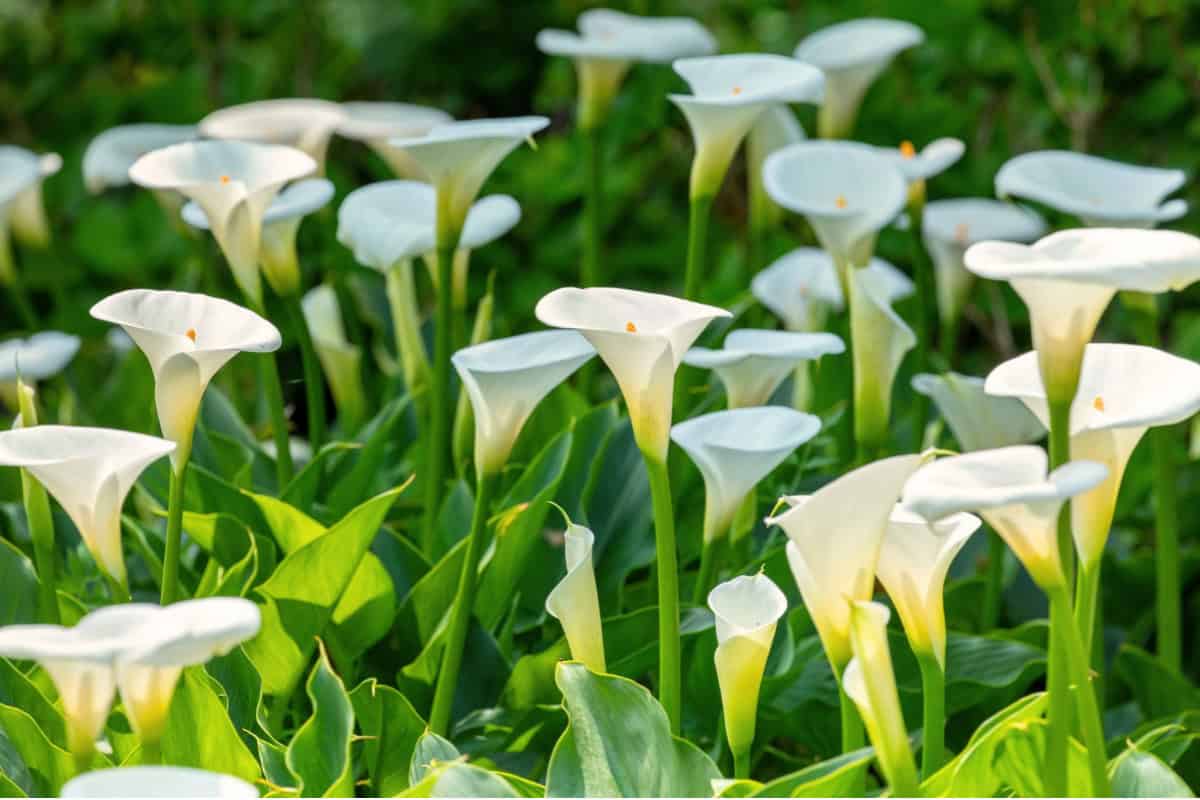
I love calla lilies. Whether they’re in containers, flower beds, or cut flower arrangements, something about them intrigues me.
But most people don’t realize there are two different groups of callas, and their care differs: What keeps one type happy can rot the other. In this guide, I’ll teach you:
- Why the two types of callas need almost opposite watering approaches.
- How to deadhead without rotting your plant.
- A grower’s trick for doubling the flower count before you even plant.
- Why a calla produces plenty of leaves but doesn’t flower (and how to fix it).
Calla lily care gets simple fast once you sort out which group your plants fall into.
Know Your Calla Type
Many calla lily problems can be traced back to following the wrong advice.
People buy a calla, follow the first care guide they find, without even knowing there are two different plants with the same name. The two groups come from different places, so advice that’s written for one can kill the other.
It’s also important to know that a calla is not a true lily — and the showy, colored part of the plant isn’t really a flower.
That funnel is a spathe, a modified leaf wrapped around a central spike called the spadix. The sturdy, leaf-like spathe is why cut callas last so long (usually longer than flowers) in a vase. Anthurium (boy flower) and peace lily are built the same way, which is why a calla doesn’t behave like a garden lily.
The plant’s actual flowers are the tiny bumps on the central spike. Pollen-producing male flowers sit near the top while seed-producing female flowers are located near the bottom.
How to Tell Calla Lilies Apart
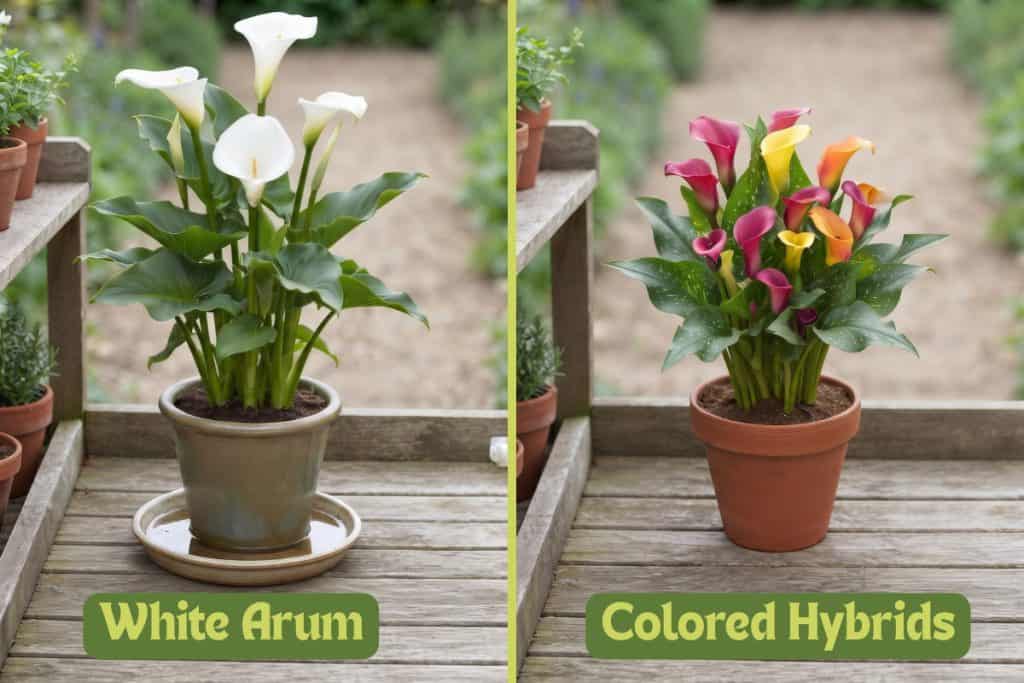
Type 1: Hardy White Arum Lily (Zantedeschia aethiopica) is also sold as Lily of the Nile. This plant is tall, with one pure-white funnel that grows 20 to 40 inches high and spreads to about 2 feet wide. It loves wet ground, stays evergreen in mild winters, and tolerates a light frost.
Type 2: Tender Colored Hybrids (Zantedeschia hybrids) are bred from Z. rehmannii and Z. elliottiana and sold as colored callas. This plant is compact, reaching 18 to 24 inches tall and about 1 foot wide. It’s found in hues of pink, yellow, orange, burgundy, and near-black. These hybrids go dormant and need to be lifted before winter.
For another flower where variety changes care, see our hibiscus guide to guarantee bigger blooms.
How to Choose and Buy Rhizomes
The rhizome you start with influences the flowers you get.
Rhizome size matters; a bigger rhizome carries more stored energy and more growing points, so it sends up more stalks and more blooms in its first season.
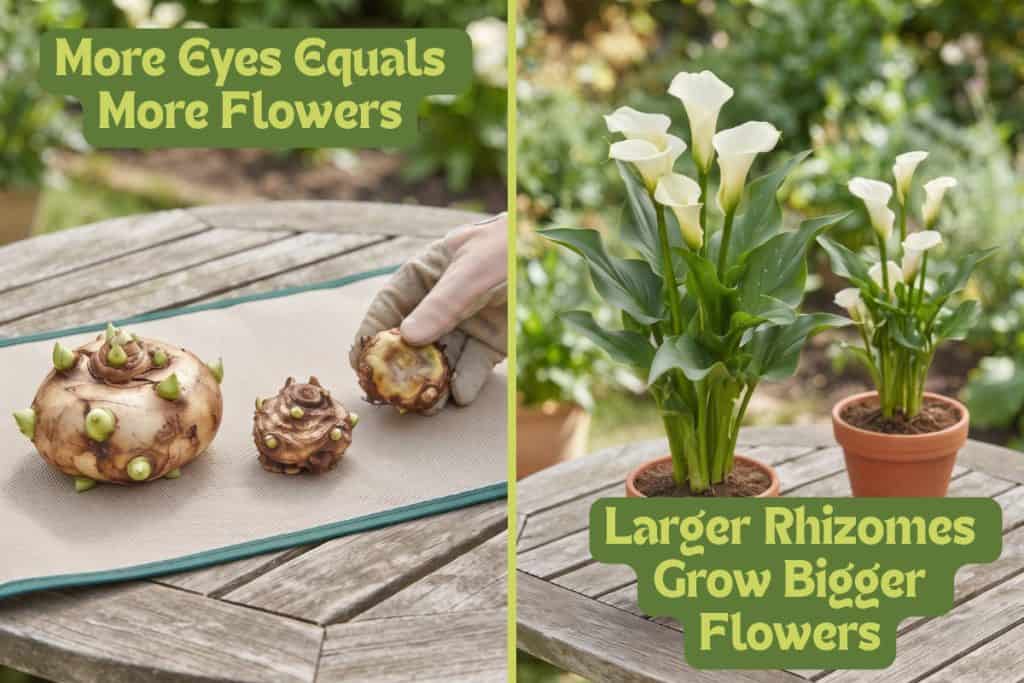
For example, a rhizome about 12 inches around usually provides 2 stalks with 3 to 4 flowers each (6 to 8 flowers in total). A bargain-bin or small rhizome can only do so much, no matter how well you grow it.
Rhizome firmness matters just as much as size. Soft or sunken spots are usually the first sign of rot, which can spread quickly once a rhizome is warm and watered.
Look for the following signs of a quality rhizome:
- More visible growing eyes mean more flower stalks.
- Those grown in the Southern Hemisphere often flower weeks earlier.
- Avoid wax-coated bulbs unless you only want one season; the wax stops the rhizome from rebuilding itself.
4 Calla Lily Varieties Worth Knowing
- Hardy Whites: Includes options like ‘Crowborough,’ ‘White Giant,’ ‘Hercules,’ and ‘Green Goddess,’ which has green-tipped spathes that florists prize.
- Full-Size Colored Hybrids: Includes options like the ‘Be My’ series, such as ‘Be My Sunshine’ (yellow), ‘Be My First Love’ (hot pink), ‘Be My Heart’ (burgundy), and ‘Be My Princess’ (pale pink), plus ‘Captain Safari’ (apricot-orange).
- Bold Colors and Markings: ‘Flame’ opens yellow and ages to orange-red; ‘Picasso’ is white with a violet throat; and you can also choose near-blacks like ‘Edge of Night,’ ‘Black Star,’ or ‘Schwarzwälder’.
- Compact and Miniatures: Includes the Z. rehmannii hybrids and dwarfs, which stay around 10 to 16 inches tall.
Essential Care Tips
Whether you have callas in your garden or a pot, care comes down to 5 things: light, water, soil, food, and warmth. Get these right, and the plant will do the rest.

Water is what usually trips people up. This is where knowing which calla lily you have becomes important.
Light is the other key factor. A calla that’s getting too little light produces lush leaves, floppy stems, and few flowers. Alternatively, too much hot afternoon sun bleaches the spathes and scorches the leaves, especially in a hot-summer climate.
Fertilizer can help balance small issues, as long as you use the right nutrients. Feeding a calla high-nitrogen fertilizer produces big leaves and few blooms, and that soft, sappy growth also encourages soft rot disease. Instead, feed lightly with low-nitrogen nutrients to support health and more blooms.
7 Key Calla Lily Care Tips
- Give the plant full sun or partial shade. In hot regions, give morning sun with filtered afternoon shade.
- When watering white arums, keep the soil steadily moist through the season.
- Colored hybrids can’t tolerate soggy soil. Let the surface dry between soaks during active growth, then taper off as the leaves yellow and stop once dormant.
- Always water at the soil, not over the leaves. Wet foliage leads to rot.
- Choose rich, loose, well-drained, and slightly acidic (pH 6.0 to 6.5) soil.
- Feed with a balanced formula (such as 8-8-8) at half strength every 4 to 6 weeks, or a low-nitrogen bloom formula (such as 5-10-10).
- Callas grow in warm weather and rest in cold, so expect growth to slow or stop as the weather cools.
Choosing Soil and a Pot
Soil needs are also different between the two groups. The white arum is easygoing and even tolerates heavy, soggy soil. Ordinary potting mix is fine for these plants.
Colored hybrids are fussier and will rot if water lingers around the rhizome, so they need a fast-draining soil mix.
If you’re planting in a garden bed, work in plenty of compost or leaf mold. In heavy clay, raise the bed or add coarse sand to help water drain. For potted hybrids, use 2 parts quality potting mix to 1 part perlite or coarse sand so water drains quickly. Add aged compost for a richer blend.
Planting for Healthy Growth
When you plant and how well the soil drains determine when, if ever, a calla rhizome wakes up.
If you plant it in cold, wet spring soil, it tends to rot before it can root. This is a common cause of rhizome loss.
Instead, wait until the soil warms and spring rains slow down for best results, especially with colored hybrids. The rhizome has no roots when you plant it, so it doesn’t need much water.
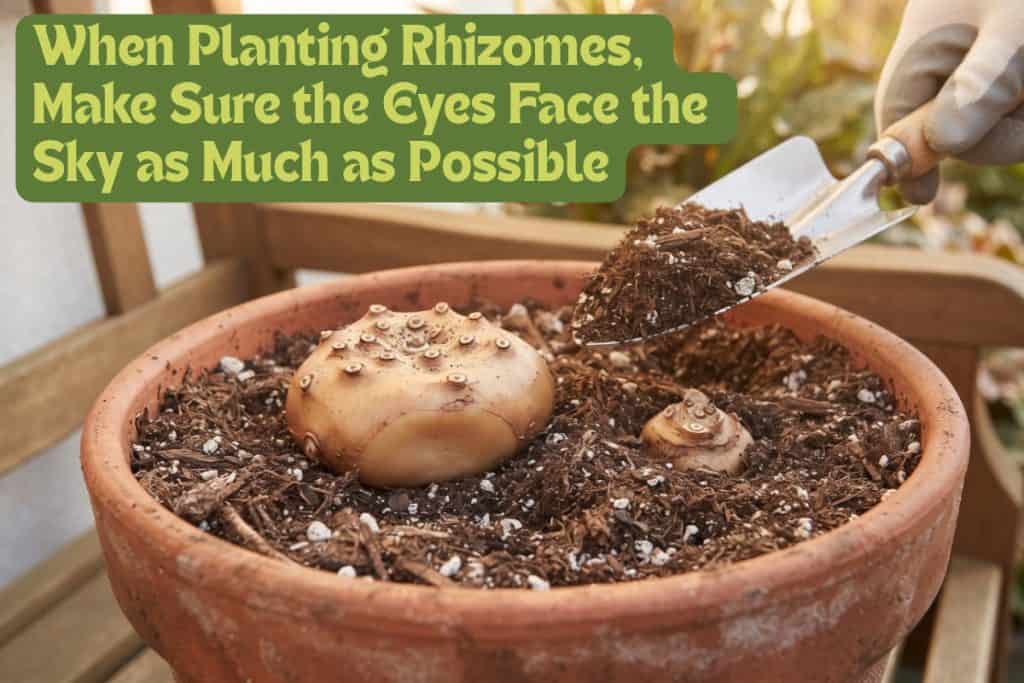
Take the time to examine each rhizome and find the side that should be planted up. One side is rounded and smooth; the other has small bumps, which are the growing eyes (where shoots and flowers come from). Remember this phrase: Eyes face the skies.
If you cannot tell which side is up, set the rhizome on its side. The shoots may have to work a little harder, but they’ll know which way to go. Expect shoots in 2 to 3 weeks in warm soil, or longer if it’s still cool.
In a short growing season, start the rhizomes in pots indoors about 4 to 6 weeks before your last frost, then move them outside once night temperatures are stable.
Plant Calla Lilies in 6 Steps
- Plant in spring, once nights stay above 50 degrees Fahrenheit and the soil has warmed.
- Break up the soil and work in compost for better drainage.
- Set rhizomes 2 to 4 inches deep in most soils. Go with 4 inches deep in hot climates and light, sandy soil.
- Space them 12 to 18 inches apart in beds and 4 to 6 inches in pots.
- Water once to settle the soil, then water sparingly until leaves appear.
- After the stems break the ground, mulch beds to hold moisture and reduce weeds.
Should You Plant in a Garden, Container, or at Water’s Edge?
Colored hybrids are happiest when planted in containers, a perk since you can control the drainage. You can also easily move them when heat waves occur or frost scares happen. They also stand out best massed in groups of 5 or more near the front of a sunny bed.
Only the white arum belongs at a pond edge or in bog-like ground.
Master soil moisture and unlock massive blooms with our complete dahlia growing guide.
Caring for Indoor Plants
Indoor calla lilies are typically gift plants, or colored hybrids forced into bloom for Easter, Mother’s Day, or Valentine’s Day.
These can live for years as houseplants if you treat them as seasonal plants.
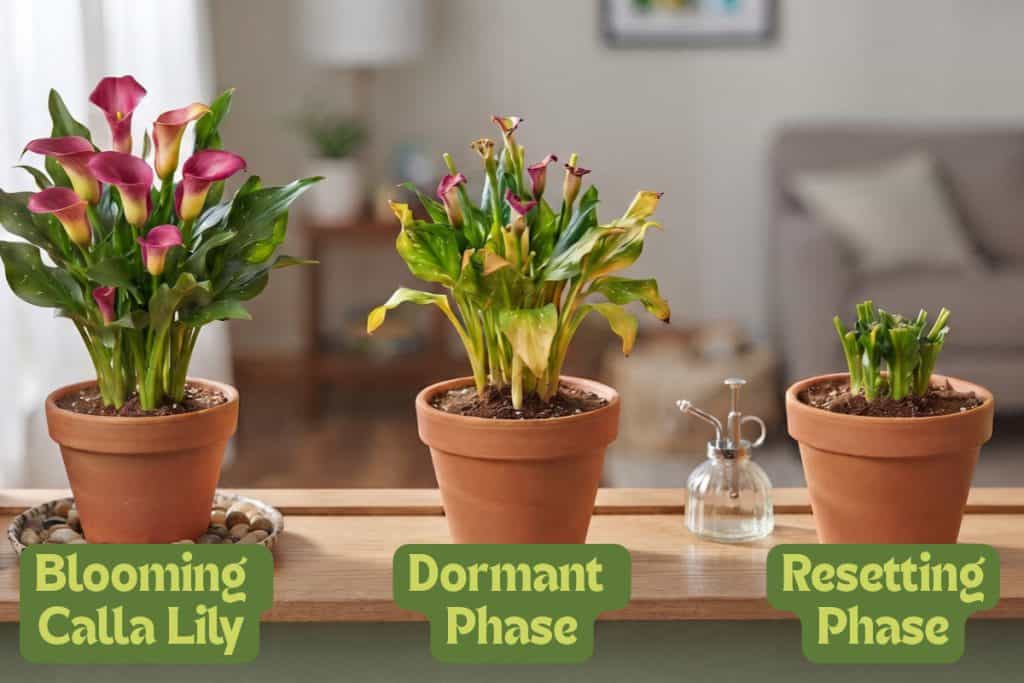
You shouldn’t expect consistent flowers; the plant has a yearly cycle of growth, rest, and regrowth. Fighting that cycle is frustrating and a waste of time.
While it’s in bloom, keep your calla lily in bright, indirect light or light morning sun and away from hot afternoon glass or heating vents that’ll dry it out and cause stress. Keeping a calla slightly pot-bound actually encourages more blooms, so resist repotting to a larger container before necessary.
Indoors, this plant is happiest from 60 to 80 degrees Fahrenheit by day and no colder than 55 degrees Fahrenheit at night. Callas also like humidity, so adding a pebble tray or humidifier nearby helps in a dry room.
After the flowers fade, the rhizome is quietly storing energy for next year. Cutting the plant down too soon robs it of that. Instead, keep it going, give it a long enough rest, and it will bloom again.
4 Tips for Indoor Colored Hybrid Care
- Water once the top 1 inch of soil feels dry.
- Never leave the pot sitting in a saucer of water.
- Give a half-rate, balanced (8-8-8 NPK) fertilizer once or twice a month while the plant is growing.
- Turn the pot occasionally so new growth is even.
How to Reset After Flowering
- Keep watering and feeding until the leaves die, since that’s when the plant stores energy.
- Move the pot somewhere dark and cool, above 32 degrees Fahrenheit but below 50 degrees Fahrenheit, for 2 to 3 months.
- Repot in fresh soil only when the rhizomes crowd or start lifting out of the soil. Move up only one pot size.
- Return the plant to light and warmth and resume watering when new shoots appear.
When Do They Bloom?
Bloom time depends on the calla lily variety and when its rhizome started growing.
In the garden, white arums bloom around June and July, while colored hybrids bloom throughout the summer after spring planting. Each spathe lasts 6 to 12 weeks and deepens in color as it ages.
Gift plants that are forced for spring holidays typically bloom off-season at first, then return to a summer rhythm outdoors. If kept warm in a pot, a colored hybrid can run from planting to first flower in about 40 days.
Why Your Plant Won’t Bloom
When a calla lily makes leaves but no flowers, it’s sending a signal. These are the usual causes, in the order worth checking:
- Too little light: This is the first thing to rule out.
- Too much nitrogen: Nitrogen feeds leaves at the expense of blooms.
- Not enough dormant rest: The plant needs to reset to flower.
- Rhizome too young or too small: There’s not enough stored energy to bloom yet.
- Partly rotted over-wintering rhizome: Causes flower-stem damage and lost energy.
How to Treat Rhizomes with GA3
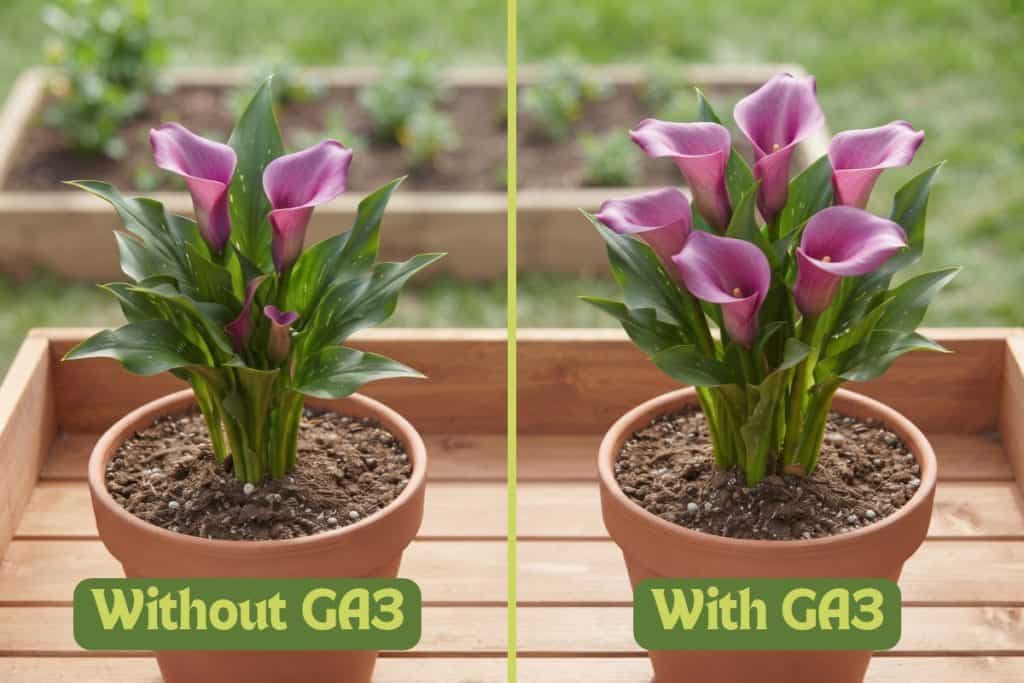
If you’re planting a lot of rhizomes, there’s a grower’s trick. Gibberellic acid, a natural plant hormone sold as GA3, nudges a hybrid rhizome to set more flower buds.
Treat the rhizomes with GA3 before planting, and the flower count can roughly double or triple. One trial lifted ‘Black Magic’ from about 2 stalks to nearly 4.
The catch is you don’t want to overdo it. Applying GA3 too strongly trades those extra flowers for twisted, deformed ones. Here’s how to use it in three steps:
- Mix a GA3 solution diluted to about 100 ppm.
- Soak the rhizomes briefly (or spray them) within 1 to 2 days of planting.
- Use it on colored hybrids, not the single-flowered white arum.
Stop foliage overload and boost your flower count with our expert marigold bloom guide.
Overwintering & Returning Each Year
Yes, calla lilies can return every year. They’re perennials, since they grow from a rhizome.
Whether yours comes back on its own depends on your winter. In mild growing zones, the rhizomes ride out the cold underground and sprout again in spring.
The big white calla is the hardier of the two types and tolerates light frost. Colored hybrids are more delicate, and a light frost will collapse them.
Here’s how to decide whether you can leave them in the ground or have to lift and store them each fall based on your region’s climate:
- USDA Zones 8 to 10: Calla lilies return on their own when planted in the ground.
- USDA Zone 7: Plant in a sheltered spot and mulch heavily.
- Colder than Zone 7: Lift the rhizomes or bring the pots indoors before frost occurs.
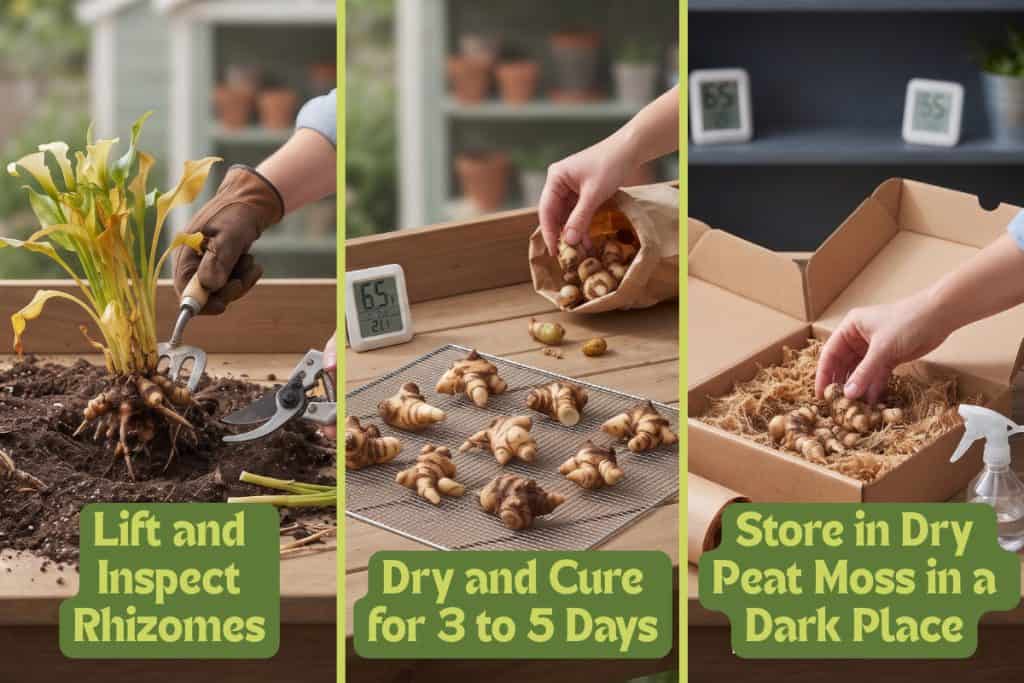
7 Steps to Overwinter Rhizomes
- Once the foliage has died back, lift the rhizomes carefully with a fork.
- Cut the stems back to about 1/2 inch and trim off the long roots.
- Cure them inside a dry, airy place at around 60 to 70 degrees Fahrenheit for 3 to 5 days to toughen the skin.
- Pack them in dry peat moss, then place inside a box or paper bag that still breathes. Don’t let them touch.
- Store them in the dark at 50 to 60 degrees Fahrenheit. Look them over every 6 to 8 weeks.
- Spritz any rhizomes that start to shrivel with water. Toss any that turn soft or smell bad.
- Replant in spring after frost.
Master bulb timing and secure bigger spring blooms with our tulip growing guide.
How to Propagate
Division is the most common way to propagate callas. It also helps thin the group and keep your plants healthier.

A clump left alone will multiply underground until the rhizomes are packed shoulder to shoulder. Above ground, this limits airflow across the leaves. Crowding like this causes disease and shrinks the blooms as the plants fight for the same food.
Each growing eye on a rhizome can become its own plant, so a healthy one can multiply many times in a single year. More eyes on a piece means additional (but smaller) flowers; fewer eyes mean fewer but larger flowers.
You should check a patch of plants every 2 or 3 years and divide only when crowded.
Growing colored hybrids from seed is possible but extremely slow, and the seed won’t be identical to its parent. Division is the sole way to “copy” one that you like.
Divide while the plant is dormant, either when you lift it out of the soil in fall or just before you replant in spring, so you cut into a resting rhizome.
Divide Rhizomes in 6 Steps
- Lift the dormant clump and brush the soil off the rhizomes.
- Find the natural splits where clumps come apart. Separate them by hand.
- Make sure each rhizome keeps at least 1 growing eye and a few roots.
- If cutting rhizomes, clean your blade with alcohol or hydrogen peroxide between cuts to prevent rot from spreading.
- Let the cut surfaces dry and seal for 1 to 2 days before planting.
- Keep the divisions dry until shoots appear, then replant.
Pests, Diseases, and Toxicity
Most calla lily trouble isn’t insect-related. Rather, it’s bacterial soft rot caused by wet soil with poor drainage.
The bacteria turn rhizomes and leaf bases soft and mushy, creating a foul smell. In severe cases, it can collapse an entire plant within days.
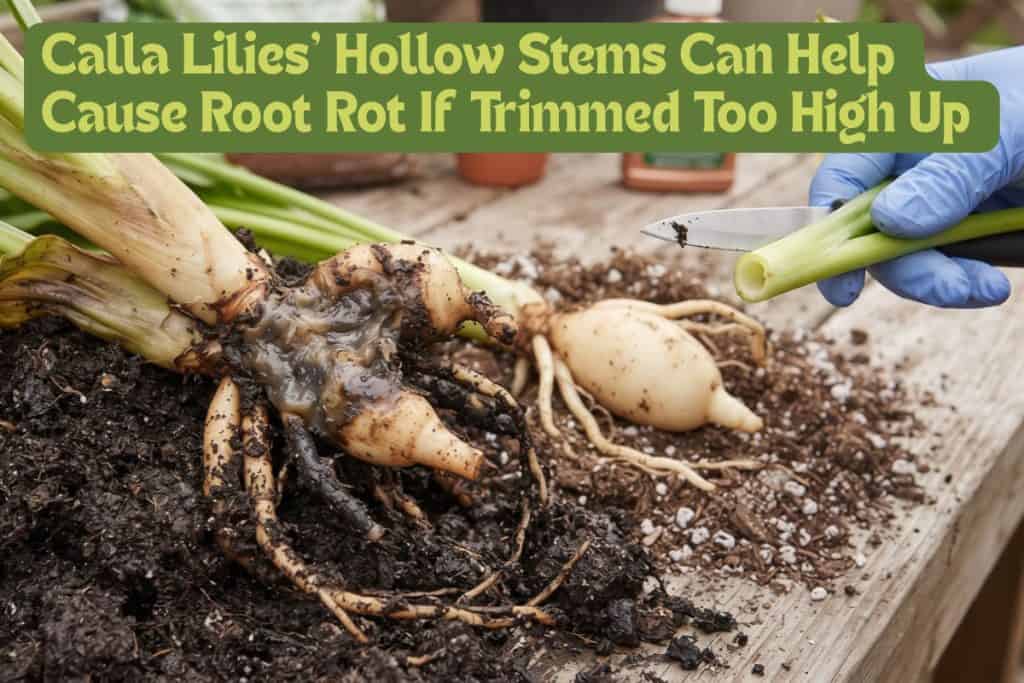
Proper care, well-draining soil, careful watering, and clean handling will all help prevent soft rot.
A calla stem is hollow, so if you snip off just the faded spathe, you leave an open tube above the rhizome. Rain and watering run down that tube and rot the plant from the top. Cut the whole stem instead, down at the base of the leaves.
3 Causes of Soft Rot
- In storage, a fresh nick or bruise on a lifted rhizome welcomes rot.
- A dormant rhizome left sitting in soggy soil triggers rot.
- After a freeze, frost-damaged tissue can set off a fast, total collapse.
The good news is soft rot is almost entirely preventable. No spray cures it, so you need to match your response to the situation and stop it before it spreads.
How to Control Soft Rot
- In hot weather, plant the rhizome deeper to keep the root zone cooler. The disease accelerates once the root zone climbs above 77 degrees Fahrenheit.
- Never cut or handle a growing plant when the foliage is wet.
- When lifting and storing, keep rhizomes dry and unbruised. Throw out any that soften or smell bad.
- If you see a small spot (under 1/2 inch), cut it out, dip the rhizome in a copper solution (about 1/2 tablespoon per gallon of water) for 1 to 2 minutes. Let it dry for 1 to 2 days before storing. If spots are larger, throw out the rhizome.
- Clear away old leaves and debris, where bacteria overwinter.
Other Pests and Viruses
Calla lilies don’t often encounter issues other than soft rot. The one disease worth watching for is a virus with no cure.
Viruses show up as mottled, streaked, or distorted leaves. Because they live inside the rhizome, every division of an infected plant carries the virus too.
To avoid viruses:
- Buy clean, virus-free stock.
- Isolate or toss any plant with mottled, distorted leaves.
- Control aphids, which spread viruses from plant to plant.
- Pick off slugs and snails that chew young leaves and spathes in damp, shady beds.
Is the Calla Lily Toxic?
The ASPCA lists callas as toxic. Every part of a calla contains needle-like calcium oxalate crystals that irritate the mouth and throat, causing drooling, pawing at the mouth, and sometimes vomiting in animals.
In most cases, ingesting the plant is painful, not deadly. Even so, it’s best to keep calla lilies out of reach of pets and small children, and wear gloves when you divide rhizomes.
Final Advice
Remember, there are 2 types of callas. Match your planting site and watering to the type you have, and you should be golden when it comes to easy care.
A rhizome that you carry through the year stores more energy and returns with more flowers each year, and it can keep doing so for years. Don’t be tempted to cut off dying leaves; they’re making next year’s flowers.
Be careful if you live in a mild, wet climate, though. White arum can get out of control and become weedy when planted along streams and wetlands. Cutting off spent flower heads before they seed and avoiding dumping rhizome pieces in wild ground helps keep it under control.
Most landscapes can utilize both types of callas. Try planting a few white callas in your dampest areas and a few colored hybrids in your garden bed borders and pots, and enjoy them for years.
Happy growing!